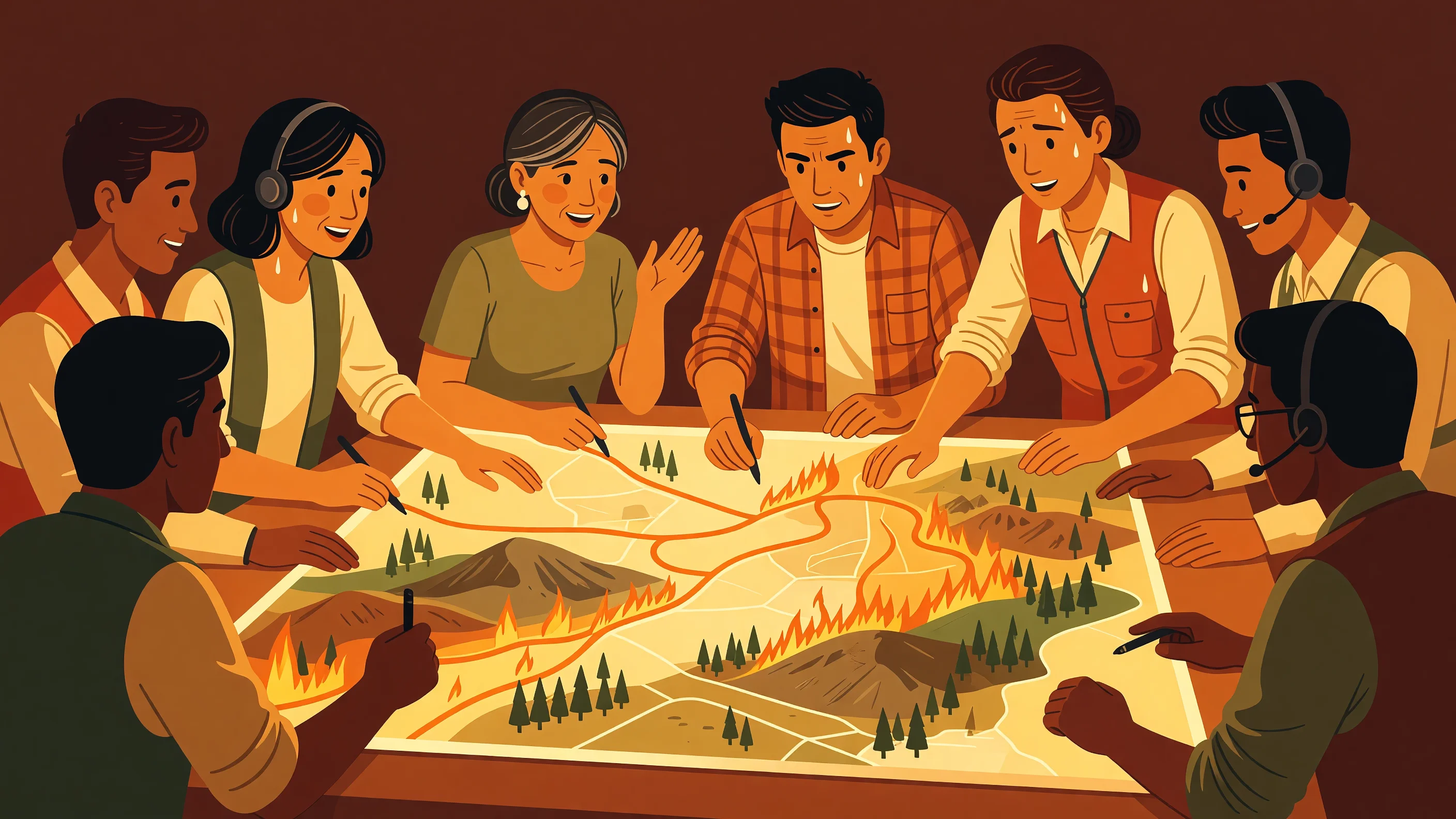
Skies Darken: The Climate Emergency at the Heart of Current Events
The resurgence of wildfires in Canada is a stark reminder of the vulnerability of our infrastructure to climate change. With over 900 active fires, including more than 200 burning out of control and severely affecting provinces like Ontario, the situation extends far beyond regional borders. Smoke plumes, pushed southward, have plunged several metropolitan areas in the northeastern United States into a thick blanket of pollution, degrading air quality for millions of citizens and casting a shadow over major international events, such as the soccer World Cup final near New York.
This environmental crisis is accompanied by sharp geopolitical tensions. According to reports from Radio-Canada and Le Figaro, the US administration has strongly criticized its northern neighbour's forest management, going so far as to suggest the imposition of countervailing tariffs. Beyond the political rhetoric, this situation highlights an inescapable reality: managing modern natural disasters requires inter-organizational coordination of unprecedented complexity, where the rapid and reliable flow of information is just as crucial as deploying personnel on the ground.
The Bottleneck of Crisis Coordination
When a major disaster strikes, municipalities, public safety services, and local businesses must collaborate instantly. Yet, from a technological standpoint, these organizations frequently face a double obstacle. On one hand, traditional information systems are often rigid, designed for routine operations, and unable to adapt within hours to the specific needs of a new crisis, such as the sudden closure of a major highway or the need to inventory temporary shelter. On the other hand, developing custom software solutions through classic programming methods requires weeks, if not months of work, a timeline incompatible with the urgency of the situation.
In this context, the improvised use of unguided, AI-assisted rapid development tools, a phenomenon often called "vibe coding", presents major risks. As the British National Cyber Security Centre (NCSC) has pointed out, producing code without rigorous auditing can introduce critical vulnerabilities, exposing emergency systems to outages or cyberattacks at the exact moment they are most needed. Digital resilience cannot be built on application improvisation.
RAG and Governed No-Code: Technological Pillars for Emergencies
To address these challenges without compromising security, two major technological concepts are essential: Retrieval-Augmented Generation (RAG) and governed no-code development.
RAG is an architecture that grounds a language model's responses in real, verified reference documents, rather than relying solely on the model's general knowledge. In the field of public safety, this means an intelligent assistant will not invent evacuation procedures; it will retrieve the exact information from the municipality's official emergency response plans. To do this, the technology relies on embeddings, or vector representations, which translate the semantic meaning of texts into mathematical form. For example, if a responder searches for information on "water supply", the system will understand the conceptual proximity to terms like "fire hydrants" or "cisterns", ensuring search results of surgical precision.
Governed no-code, on the other hand, allows crisis management professionals to design tracking applications without writing a single line of code. Unlike rogue development, this approach runs within a standardized and secure application framework. Visual components are pre-audited, and the generation of specific features is confined to isolated environments, or sandboxes, eliminating the risk of introducing security vulnerabilities or uncontrolled external software dependencies.
The ProductivIA Response: Application Resilience and Document Memory
The ProductivIA platform embodies this philosophy of resilience through no-code and document grounding, offering institutions and businesses tools that can be deployed immediately during a crisis.
Thanks to the Fabrique application, public safety officials can design and deploy tracking tools tailored to the current situation in just a few minutes. Whether it is a registration form for evacuated citizens, a dashboard for tracking equipment, or a coordination map for volunteer teams, the application is generated from a simple description in French. The code generated in the background is automatically audited and sandboxed by the platform, ensuring the tool is stable, secure, and immediately accessible from any browser without requiring complex local installations.
At the same time, the Base documentaire application centralizes all of the organization's emergency protocols, zoning maps, and crisis directories. Using RAG technology, it transforms this mass of static documents, such as PDF files, spreadsheets, and procedure manuals, into a collective memory searchable in natural language. A dispatcher or decision-maker can ask: "What is the evacuation procedure for the northern sector if the main bridge is inaccessible?" and receive a precise, sourced, and hallucination-free response directly from the municipality's official documents.
Toward a Sovereign Public Safety Infrastructure
Managing climate crises leaves no room for operational failures or sensitive data leaks. This is why the ProductivIA architecture relies on complete isolation through logical silos. Data related to emergency plans, critical infrastructure, and citizens remains confined within the organization's environment, never to be shared for training third-party models.
For public institutions subject to strict regulatory requirements, such as Law 25 in Quebec, this approach can be coupled with sovereign artificial intelligence models, like those provided by Matania, which are hosted entirely within Quebec. Similarly, on the hardware side, using a clean, native operating system like Boréal-OS ensures the availability of emergency workstations, even on older equipment, while bypassing the forced obsolescence cycles of major software vendors.
Resilience in the face of tomorrow's crises will not depend solely on the strength of our dikes or the speed of our firefighters; it will also rely on our ability to deploy agile, transparent, and immediately adaptable digital tools in a fully sovereign manner to meet the unpredictability of our climate.