The Era of Hardware Subscriptions: The Shift Toward Digital Leasing
Acquiring a computer or smartphone is beginning to mirror the automotive industry. Tech giant Apple recently formalized the US launch of its "Apple Upgrade" program, in partnership with financial services company Klarna. This model allows consumers to lease phones, tablets, watches, and computers for a fixed monthly fee. At the end of the contract, users can return the device to lease a new one, committing themselves to an uninterrupted cycle of upgrades.
This shift toward Hardware-as-a-Service (HaaS) marks a profound transition in our relationship with technology ownership. Consumers no longer own their work tools; they lease temporary access to them. While this model promises to soften the initial financial blow of rising high-end device prices, it raises fundamental questions about economic dependence, personal data management, and the digital sector's environmental footprint.
The Economic and Environmental Mechanics of Hardware Lock-In
For major tech developers, the widespread adoption of subscriptions meets a clear business imperative: securing recurring, predictable revenue. At a time when the global smartphone and PC markets are experiencing slower upgrade cycles, perpetual leasing encourages users to replace their devices more frequently than necessary. According to analyses published by financial media outlet Bloomberg, this strategy also helps mask overall price increases, which have been driven up by component shortages and rising manufacturing costs.
On an environmental level, this planned acceleration of product lifecycles directly contradicts the principles of digital sobriety. The Global E-waste Monitor, published by the United Nations Institute for Training and Research (UNITAR), reveals that electronic waste generation is growing five times faster than documented recycling. Manufacturing a new device accounts for the bulk of its carbon footprint, largely due to the extraction of rare earth elements and precious metals required for microchips. Encouraging the systematic replacement of perfectly functional machines only worsens this impact.
Furthermore, integrating "buy now, pay later" (BNPL) consumer credit services, such as those offered by Klarna, exposes households to risks of passive over-indebtedness. A Statistics Canada study on financial behaviour shows that accumulating micro-subscriptions and installment payments complicates household budgeting, creating a form of financial captivity where access to daily communication tools depends on a perpetual monthly payment.
The Quebec Alternative: Decoupling System, Application, and Machine
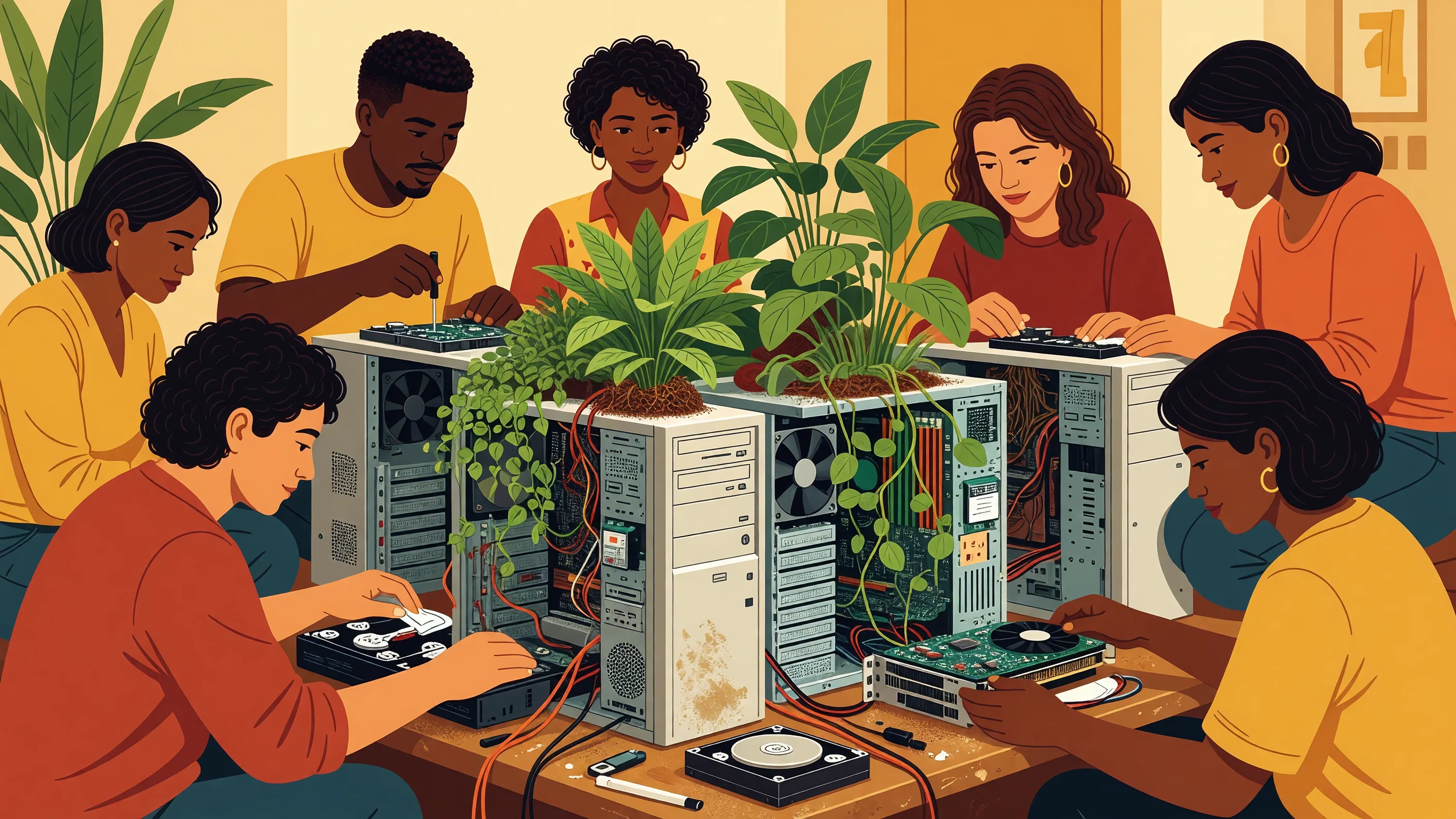
In contrast to this linear, centralized consumer logic, Quebec's sovereign ecosystem offers a diametrically opposed approach based on hardware durability and software independence. Rather than replacing machines declared obsolete by the demands of proprietary operating systems, it is now possible to extend their useful life by five to ten years.
This hardware rehabilitation relies on the first layer of the sovereign stack: Boréal-OS. This native operating system, designed in Quebec, installs directly onto the hard drives of older computers or those deemed obsolete by Windows 11 standards (such as machines lacking a TPM 2.0 chip or Secure Boot). By replacing a heavy, restrictive system with a lightweight, secure distribution, Boréal-OS breathes new life into school, municipal, and corporate computer fleets, preventing massive and unnecessary procurement costs.
Once the machine is revived by Boréal-OS, access to modern productivity tools is delivered directly through the browser via the ProductivIA application platform. Because ProductivIA applications run within a standard browser without requiring heavy local installations, hardware requirements drop dramatically. A school or business can run cutting-edge artificial intelligence tools on a computer nearly a decade old, without experiencing slowdowns or technical roadblocks.
Regaining Control: The Role of Nuage and the Assistant
Beyond hardware preservation, this sovereign, no-code architecture redefines data governance. Under the perpetual leasing model, users are often locked into closed cloud ecosystems and advertising profiles embedded directly within the operating system.
The ProductivIA platform breaks this confinement with the Nuage application, which offers transparent, user-controlled storage. All data generated by the platform's applications is securely siloed within the organization, in compliance with Quebec's Law 25 on the protection of personal information. Users know exactly where their files reside and can export them at any time, eliminating vendor lock-in.
In addition, daily task orchestration is managed by the platform's central Assistant. This intelligent agent interacts with various applications (such as Email, Calendar, or Document Base) using standardized protocols. If an organization wishes to use a local, sovereign artificial intelligence model to process sensitive information, the administrator can configure the Assistant to route requests to Quebec-based provider Matania, without altering the user interface or daily workflows.
This modularity demonstrates that it is possible to reconcile technological innovation, fiscal responsibility, and environmental stewardship. Digital sovereignty is not just about choosing where our data is hosted, but also about deciding the pace at which we replace our physical tools.
Going Further
The transition toward business models based on usage rather than ownership invites us to rethink our technology procurement policies. Public institutions and Quebec businesses now have concrete tools to reject planned obsolescence. Research on the circular economy and the right to repair offers promising pathways for structuring sustainable IT fleets, where software adapts to the machine, and not the other way around.