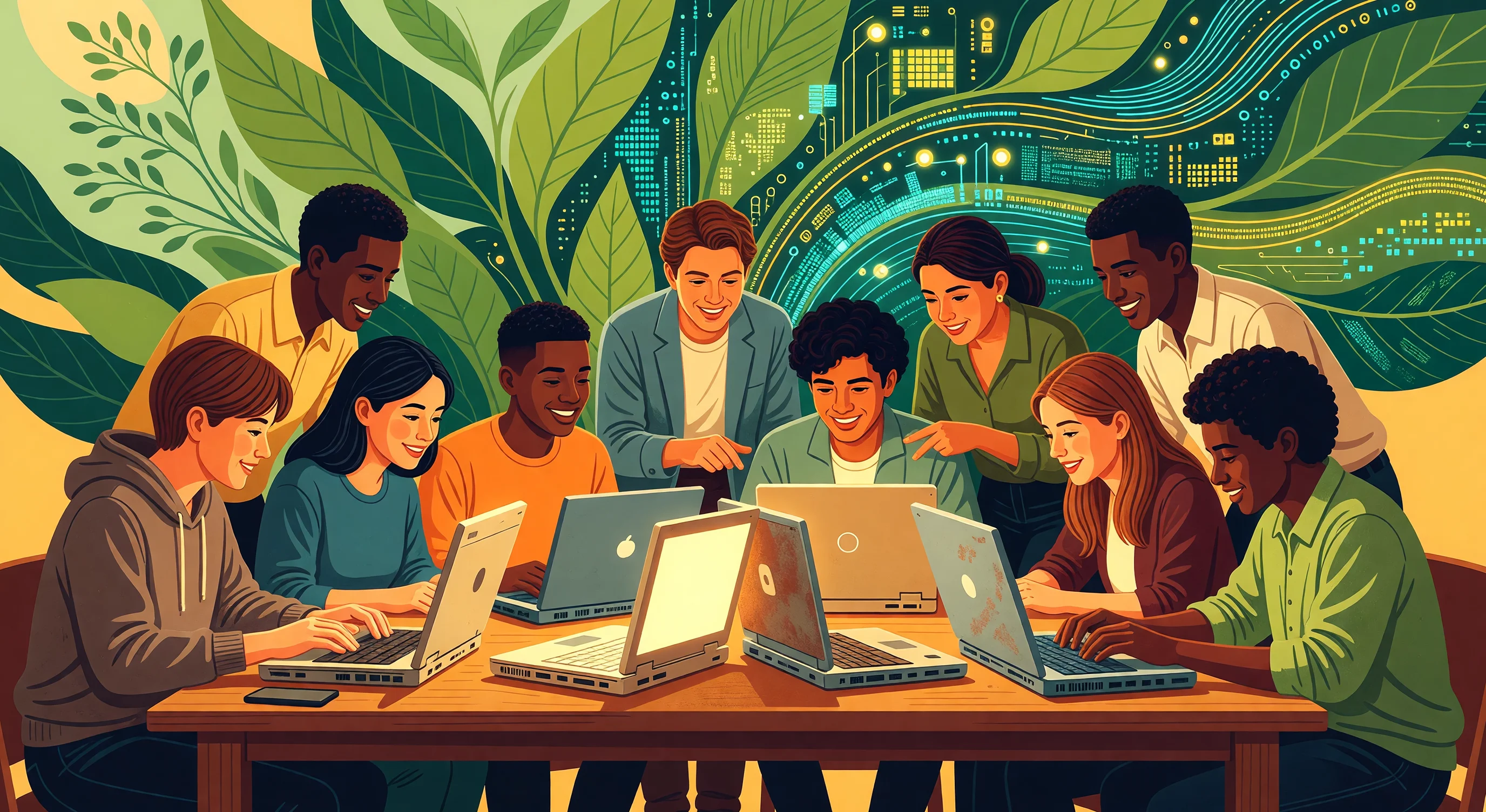
The $599 Laptop War: A Mirage of Accessibility
The information technology industry is undergoing an aggressive price repositioning phase. Recently, at the Computex trade show, manufacturer Dell unveiled a new version of its iconic XPS 13, offered at a temporary introductory price of $599 for students. This offensive directly targets Apple's MacBook Neo, while aligning with the promise of more affordable chips, such as Qualcomm's Snapdragon C line, which aims to power Windows machines priced around $300.
At first glance, this price drop seems like excellent news for families, students, and small businesses. It promises to democratize access to modern productivity tools and the computing power required to run the latest generation of artificial intelligence applications. However, behind this apparent corporate generosity lies a much darker economic and environmental reality. Must access to digital power inevitably depend on the continuous production of new machines?
The Hidden Cost of New Hardware: The Imperative of Digital Sobriety
Acquiring a new computer, even a cheap one, comes with a major ecological cost that is often ignored. According to reports from the French Agency for Ecological Transition (ADEME), nearly 80 percent of a digital device's carbon footprint is generated during its manufacturing phase. The extraction of rare metals, component refining, and international transport represent a colossal energy expenditure. Buying a new machine, even an economical one, directly contributes to resource depletion and the accumulation of electronic waste.
This problem is exacerbated by planned software obsolescence. The arrival of Windows 11 and its strict hardware requirements, such as the presence of a TPM 2.0 security chip or recent-generation processors, condemns millions of perfectly functional computers. A study published by analysis firm Canalys estimates that the end of support for Windows 10 could send nearly 240 million PCs to landfills globally due to a lack of official compatibility with Microsoft's new operating system. This situation leaves educational institutions and organizations facing an untenable dilemma: spend significant sums to upgrade their IT fleets or keep unsecured systems.
Boréal-OS: Breathing New Life into Condemned Machines
It is at this intersection of economic constraints and ecological responsibility that Quebec's sovereign ecosystem positions itself, offering a major technological breakthrough. Rather than participating in the race for new hardware, the solution lies in upgrading what already exists. This is the fundamental role of Boréal-OS, a sovereign native operating system designed in Quebec.
Boréal-OS installs directly onto the hard drives of computers declared obsolete by major proprietary software publishers. By replacing Windows or macOS with this lightweight, secure Linux distribution, an eight- to ten-year-old machine regains performance comparable to that of a brand-new device. Boréal-OS bypasses the requirements for TPM 2.0 chips or latest-generation processors, while guaranteeing regular security updates and a complete absence of advertising telemetry. For a school or community organization, this approach extends the useful life of an IT fleet by five to ten years, avoiding massive acquisition costs and unjustified electronic waste.
ProductivIA: Application Power Without Hardware Upgrades
Once the machine is revitalized by Boréal-OS, the question of accessing modern applications and artificial intelligence remains. This is where the second layer of the sovereign stack comes in: the ProductivIA application platform.
Designed entirely to run in a web browser, ProductivIA requires no heavy local installation or excessive graphics processing power on the workstation. The user's computer acts as a display terminal, while task orchestration and complex calculations are securely offloaded. This no-code architecture eliminates the need to maintain local software dependencies and drastically reduces the attack surface for cyber threats.
For educational or family use, users gain instant access to cutting-edge tools:
- ÉtudeIA: This dedicated learning application provides students with a personal tutor. It uses RAG (retrieval-augmented generation) technology to anchor its responses exclusively in documents provided by the teacher, thereby avoiding the common hallucinations of generalist artificial intelligence models.
- GoIA: An experimental and comparison space that allows users to submit the same query to multiple language models in parallel. Users can evaluate the biases and strengths of each engine, including Quebec's sovereign model, Matania, which is hosted locally to ensure compliance with Law 25 on the protection of personal information.
A Concrete Response for Education and Families
The combination of Boréal-OS for the hardware layer and ProductivIA for the application environment demonstrates that another path is possible. Digital accessibility must no longer be synonymous with the overconsumption of plastic and silicon. By rejecting the technological lock-in imposed by Silicon Valley giants, Quebec is equipping itself with a complete, eco-responsible, and sovereign technological stack.
For school boards and low-income families, the financial equation changes completely. It is no longer necessary to watch for sales on entry-level laptops with limited lifespans. Existing machines, once freed from their original software constraints, become open windows to a modern, secure, and privacy-respecting workspace. True innovation does not lie in creating a new need, but in the intelligent optimization of what we already own.