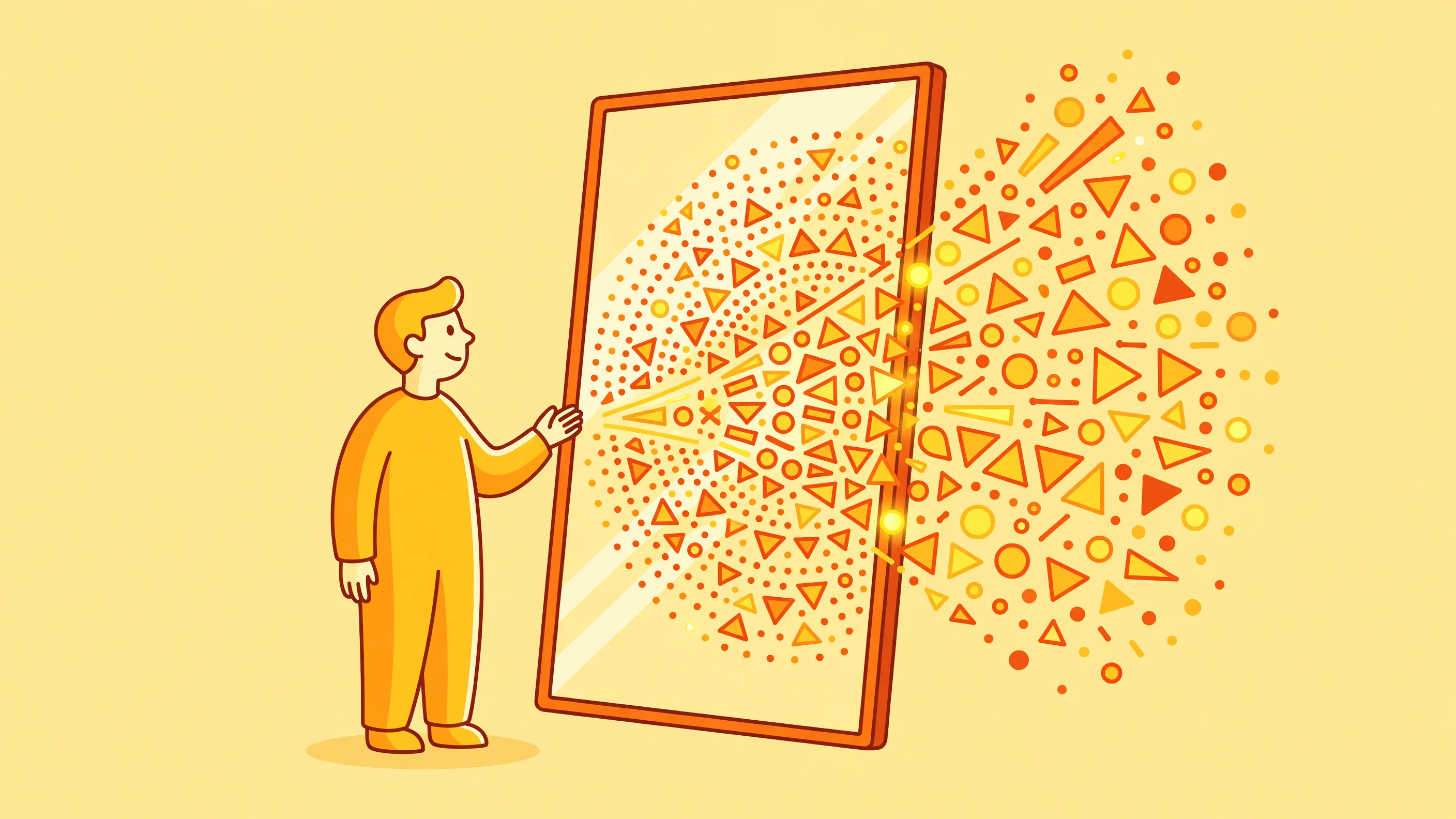
Infinity at the Tip of the Brush
The contemporary Japanese artist Yayoi Kusama has passed away in Tokyo at the age of 97, as reported by the daily newspaper Le Devoir. Her work, celebrated around the globe for its repetitive polka dots, colourful pumpkins, and immersive installations called "Infinity Mirror Rooms," drew its origins directly from childhood hallucinations. Rather than suffering from these perceptual alterations, Yayoi Kusama chose to tame them and project them onto the canvas, turning them into a universal artistic language.
Her passing offers a unique perspective to analyse a phenomenon that now preoccupies artificial intelligence developers: algorithmic hallucination. While hallucination was the engine of boundless creation for the artist, it represents a major systemic challenge for modern computing. The industry faces a constant tension between the need for absolute accuracy in business applications and the desire to preserve creative freedom of association for artistic production.
Artificial Hallucination: Between Logic and Wandering
In computer science, the term hallucination describes the tendency of a large language model (LLM) to generate factually false claims, invent sources, or structure reasoning that lacks real coherence. Yet, from a purely mathematical standpoint, the algorithm is not making an error: it is executing a statistical prediction. It selects the next most probable word based on its training weights. As a study by Stanford Human-Centered Artificial Intelligence indicates, hallucination is an intrinsic consequence of the probabilistic flexibility of these models.
This algorithmic plasticity is twofold. On one hand, it proves problematic when drafting contracts, administrative policies, or medical diagnoses, where the slightest approximation can be fatal. On the other hand, it constitutes the very foundation of creative generation. Without this ability to deviate from the most direct path, artificial intelligence would be incapable of composing original metaphors or generating novel graphic compositions.
Taming Drift with RAG in the Document Base
For organisations subject to strict compliance requirements, the reliability of information must be one hundred percent. This is where the architecture of the ProductivIA platform intervenes to neutralise the cognitive drift of language models. The Document Base application applies the RAG (Retrieval-Augmented Generation) technique and vector embeddings to this end.
The mechanism consists of restricting the search scope of the artificial intelligence. Rather than allowing the model to draw from all its general training data, RAG structures the documents provided by the user (reports, procedures, collective agreements) into the form of embedding vectors, which numerically represent the meaning of words. When a query is made, the ProductivIA Assistant does not extrapolate: it extracts only the relevant document segments to formulate a verifiable response. This approach eliminates the risk of false statements by anchoring the answer in the organisation's own sources.
Unleashing the Obsession with Form in the Images Application
Conversely, the Images application from ProductivIA uses this potential for probabilistic wandering as a tool for pure creation. Image diffusion models work by successive approximations. They start from random pixel noise to bring out coherent shapes, akin in some ways to the hallucinatory process described by Yayoi Kusama when floral patterns invaded her visual field.
By adjusting generation parameters, creators can exploit this variability. A high temperature prompts the system to drift toward less probable visual associations, leading to highly complex textures and structures. For graphic designers, illustrators, and marketing teams, this capacity for extrapolation becomes an infinite source of visual ideas, capable of renewing styles without the rigidity of traditional stock photo libraries.
A Modular Architecture for the Right Balance
Managing this duality relies on a clear separation of tools. The sovereign ecosystem of ProductivIA allows models to be used differentially depending on the task. Administrators can direct critical writing workflows to constrained and documented models, while allowing users to unleash visual generators for artistic exploration.
This modular approach meets the requirements of Law 25 and modern governance policies. It demonstrates that high-performance artificial intelligence is not a monolithic system, but rather an orchestrated suite of tools where the user retains control over the required level of accuracy and creativity.