The RAM Shockwave: Tim Cook Sounds the Alarm
The announcement sounded like a warning for household and organizational budgets alike. In an interview with the Wall Street Journal, Apple CEO Tim Cook confirmed that price increases on the brand's devices are now inevitable. The culprit: a dramatic rise in procurement costs for random-access memory (RAM) chips and flash storage.
This situation, which the executive described as unsustainable, is not the result of a simple market fluctuation, but rather a structural transformation of the semiconductor industry. While consumers had grown accustomed to a steady decline in the cost per gigabyte, that trajectory has reversed. This price hike is set to affect Apple's entire product lineup, from smartphones to desktop computers, putting additional financial pressure on the IT fleets of businesses and public institutions.
The Data Centre Gold Rush Saturates Factories
To understand the mechanisms behind this price hike, one must look to the giant data centres powering generative artificial intelligence. Large language models (LLMs) require colossal computing infrastructure. These servers do not just demand high-performance graphics processing units (GPUs); they also require massive amounts of high-bandwidth memory (HBM) and latest-generation RAM (DDR5).
According to analysis reports from TrendForce, major memory chip manufacturers, such as Samsung, SK Hynix, and Micron, have redirected a substantial portion of their production lines to meet this highly lucrative industrial demand. By prioritizing the manufacturing of chips destined for AI servers, these microelectronics giants have created an artificial scarcity in the consumer memory market. Consequently, the production costs of basic components have skyrocketed, forcing computer manufacturers to pass these expenses on to end buyers. The general public and institutions are thus indirectly paying the bill for the global race for AI infrastructure.
Planned Obsolescence in the Era of Artificial Intelligence
This hardware inflation comes at a particularly critical time for IT fleet managers. Microsoft's gradual phasing out of Windows 10 support, combined with the strict hardware requirements of Windows 11 (notably the presence of a TPM 2.0 security chip and recent processors), was already condemning millions of perfectly functional computers to the scrap heap.
The obligation to upgrade hardware, now coupled with a general rise in the price of new machines, places schools, municipalities, and SMEs in a major financial and environmental dilemma. According to data from the United Nations' Global E-waste Monitor, electronic waste is one of the fastest-growing waste streams in the world. Yet, the manufacturing of a new computer accounts for nearly 80% of its total carbon footprint over its entire lifecycle. Extending the lifespan of existing equipment is therefore no longer just a budget-saving measure; it is an imperative for digital sobriety.
Boréal-OS and ProductivIA: Hardware and Software Sovereignty Through Sobriety
Faced with this dual constraint of forced obsolescence and price inflation, Quebec's sovereign ecosystem offers a disruptive approach. Rather than submitting to the upgrade cycle imposed by tech giants, it is now possible to decouple application performance from the physical power of the machine.
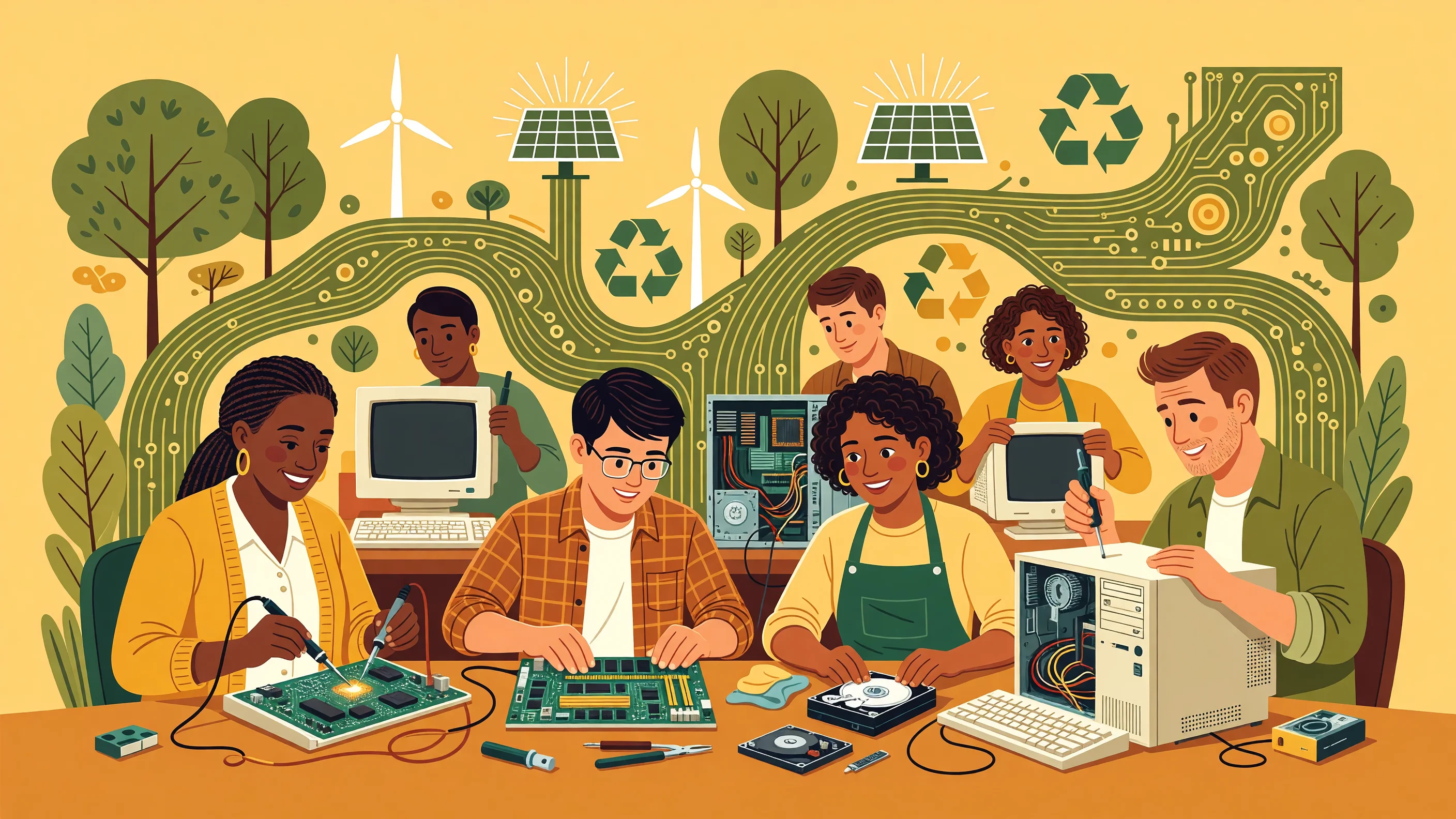
At the first level of this technology stack is Boréal-OS, a sovereign native operating system designed in Quebec. This lightweight Linux distribution installs directly onto the hard drives of computers declared obsolete by proprietary commercial systems. Boréal-OS bypasses artificial hardware requirements: it requires neither a TPM 2.0 chip nor a latest-generation processor to run smoothly and securely. By giving existing desktop computers an extra 5 to 10 years of useful life, Boréal-OS neutralizes the impact of component inflation by simply avoiding the purchase of new hardware.
A Lightweight Architecture to Bypass Tech Inflation
Once the machine is rehabilitated with Boréal-OS, access to modern work tools is provided through the ProductivIA platform. Running entirely within a standard web browser, this no-code application suite does not strain the computer's local resources. The machine's RAM is not saturated by heavy, locally executed processes, as the intelligence and data processing are efficiently offloaded.
Users can thus interact with the ProductivIA Assistant, which orchestrates requests and calls the necessary services without requiring expensive local AI chips. If an organization requires absolute data confidentiality, administrators can configure the platform to route requests to the sovereign Matania engine, physically hosted in Quebec. This architecture provides a high-performance, secure work environment that complies with Law 25, all on a computer that would normally have ended up in a landfill.
True innovation no longer lies in the frantic race for the latest processor or the most expensive machine. It is found in the ability to design smart, lightweight software architectures capable of maximizing the use of existing hardware resources. By combining a resource-efficient operating system with a decentralized application platform, Quebec organizations now have a concrete tool to protect their budgets while reducing their environmental footprint.