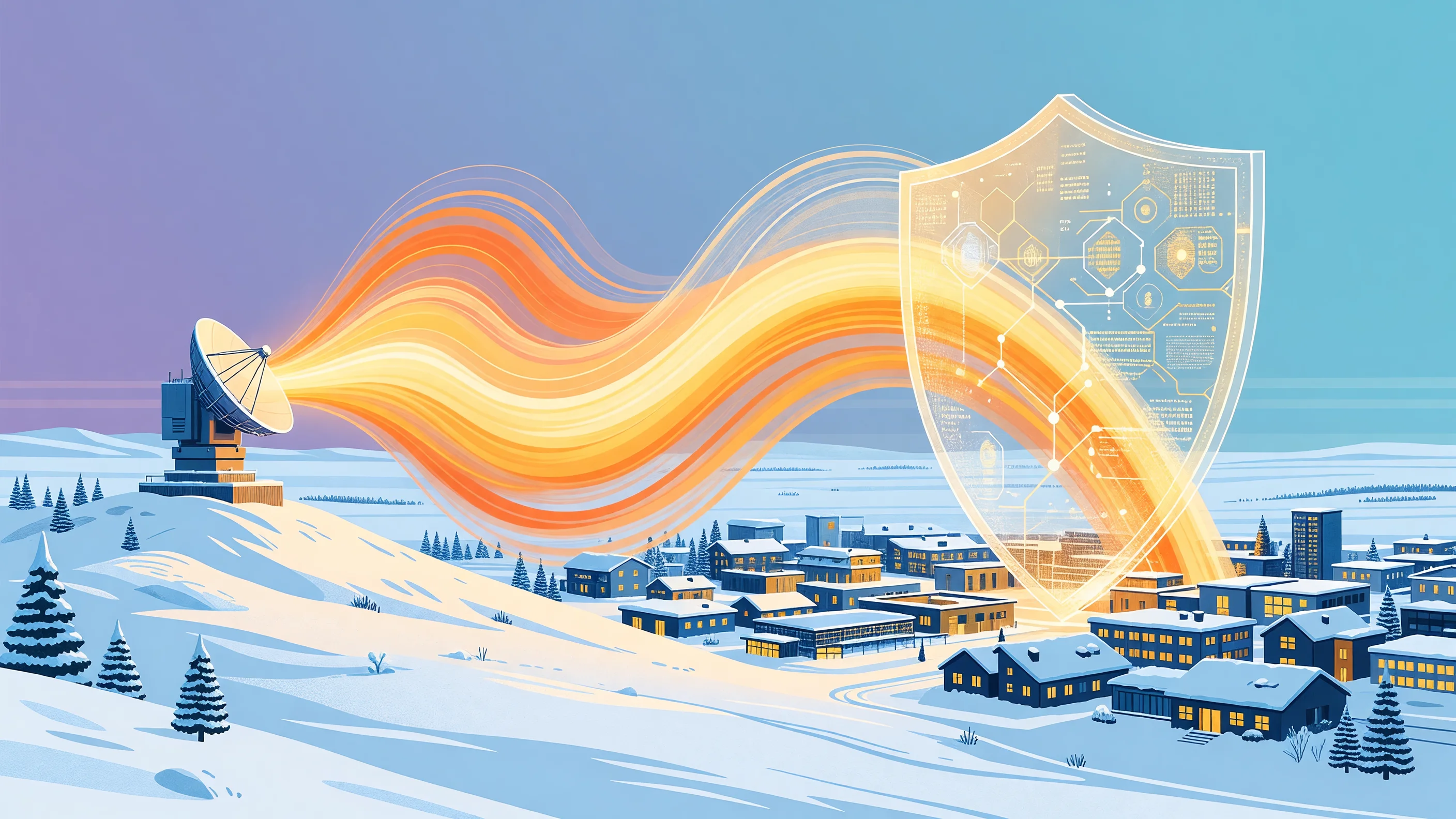
Arctic Under Surveillance: A $2.5-Billion Contract
The Government of Canada has finalized a major agreement with Australia to acquire an over-the-horizon radar system for Arctic defence. Valued at nearly $2.5 billion, this project aims to modernize the detection capabilities of the North American Aerospace Defense Command (NORAD). Designed by BAE Systems Australia, this system will monitor the continent's northern approaches over thousands of kilometres, far beyond the limits of conventional radar.
This announcement, reported by Radio-Canada and The Globe and Mail, comes amid growing geopolitical tensions in the Far North, where ice-free shipping lanes are drawing the attention of major global powers. While Ottawa presents this acquisition as a historic milestone for national security, it also highlights a more uncomfortable reality: the country's inability to independently design and produce the critical technologies needed to protect its own territory.
Over-the-Horizon Radar: A Technical Feat Tied to Dependence
To understand the importance of this acquisition, it is worth looking at how over-the-horizon radar (OTHR) technology works. Unlike conventional radars whose range is limited by the curvature of the Earth, over-the-horizon systems emit high-frequency radio waves toward the ionosphere. These waves bounce off this layer of the atmosphere to reach targets at very long distances, before returning to the receiver along the same path.
This technology requires cutting-edge scientific expertise and massive infrastructure. Australia, through its Jindalee Operational Radar Network (JORN), has been refining this method for decades. By importing this turnkey solution, Canada is quickly closing a strategic gap, but it binds itself to a foreign supply chain for the maintenance, updates, and evolution of its surveillance systems.
This situation perfectly illustrates the concept of technological dependence. When a state does not control the design of the tools that ensure its security, it exposes itself to supply chain disruptions or unilateral decisions by the supplying country. This observation, obvious in the military domain, applies with equal force to the civilian and corporate worlds through the management of digital infrastructure.
From the Physical Frontier to the Digital Frontier
When the protection of our physical borders depends on imported technologies, what about the security of our digital borders? On a daily basis, public institutions, school boards, and Quebec businesses entrust nearly all of their data and decision-making processes to foreign tech giants, commonly known as hyperscalers.
This digital dependence exposes organizations to vulnerabilities similar to those of a state without an independent defence industry. Centralizing artificial intelligence infrastructure and operating systems with a single vendor creates a single point of failure. A major outage, a cyberattack targeting a US cloud provider, or an extraterritorial legislative change, such as the CLOUD Act or Section 702 of the FISA Act, can instantly paralyze entire sectors of our economy or compromise the confidentiality of personal information, in direct contradiction with Quebec's Law 25.
Faced with this reality, the pursuit of local autonomy becomes a strategic necessity. This is precisely where the sovereign Quebec ecosystem steps in, offering concrete alternatives at every level of the technology stack.
Boréal-OS and Matania: Rebuilding Autonomy from the Ground Up
To break free from dependence on tech monopolies, the response must be comprehensive, addressing both hardware and software intelligence.
At the hardware level, dependence often manifests as planned obsolescence. The technical requirements of Windows 11, such as the presence of a TPM 2.0 chip or a recent processor, force organizations to discard computer fleets that are otherwise perfectly functional. This is where Boréal-OS, a sovereign native operating system designed in Quebec, provides a concrete solution. By installing directly on the hard drive, this lightweight and secure Linux distribution adds 5 to 10 years of useful life to machines declared obsolete by American giants. For a school or a municipality, adopting Boréal-OS makes it possible to keep existing hardware, thereby reducing electronic waste and forced import expenses, while guaranteeing a system free of intrusive telemetry.
At the artificial intelligence level, sovereignty requires control over language models. Sending queries containing school, medical, or legal data to foreign servers represents a major compliance risk. The sovereign AI engine Matania, physically hosted in Quebec, allows organizations to run models from the Qwen family without data crossing borders. Seamlessly integrated into the ProductivIA application platform, Matania ensures compliance with Law 25 by keeping data flows local.
By combining Boréal-OS on the physical machine with the ProductivIA no-code platform in the browser, powered by the Matania AI engine, organizations gain access to a complete and fully autonomous technology stack. The end user does not need to write a single line of code to benefit from this security: the platform manages data orchestration and protection in the background.
Toward Global Resilience
Canada's purchase of the over-the-horizon radar system is a reminder that global security requires massive investment and a long-term vision. However, the resilience of a society is measured not only by the range of its military radars, but also by its ability to protect its daily data, institutions, and businesses from foreign interference and technological dependence. Developing and supporting local solutions like Boréal-OS, ProductivIA, and Matania is an essential step toward true territorial sovereignty, both physical and digital.