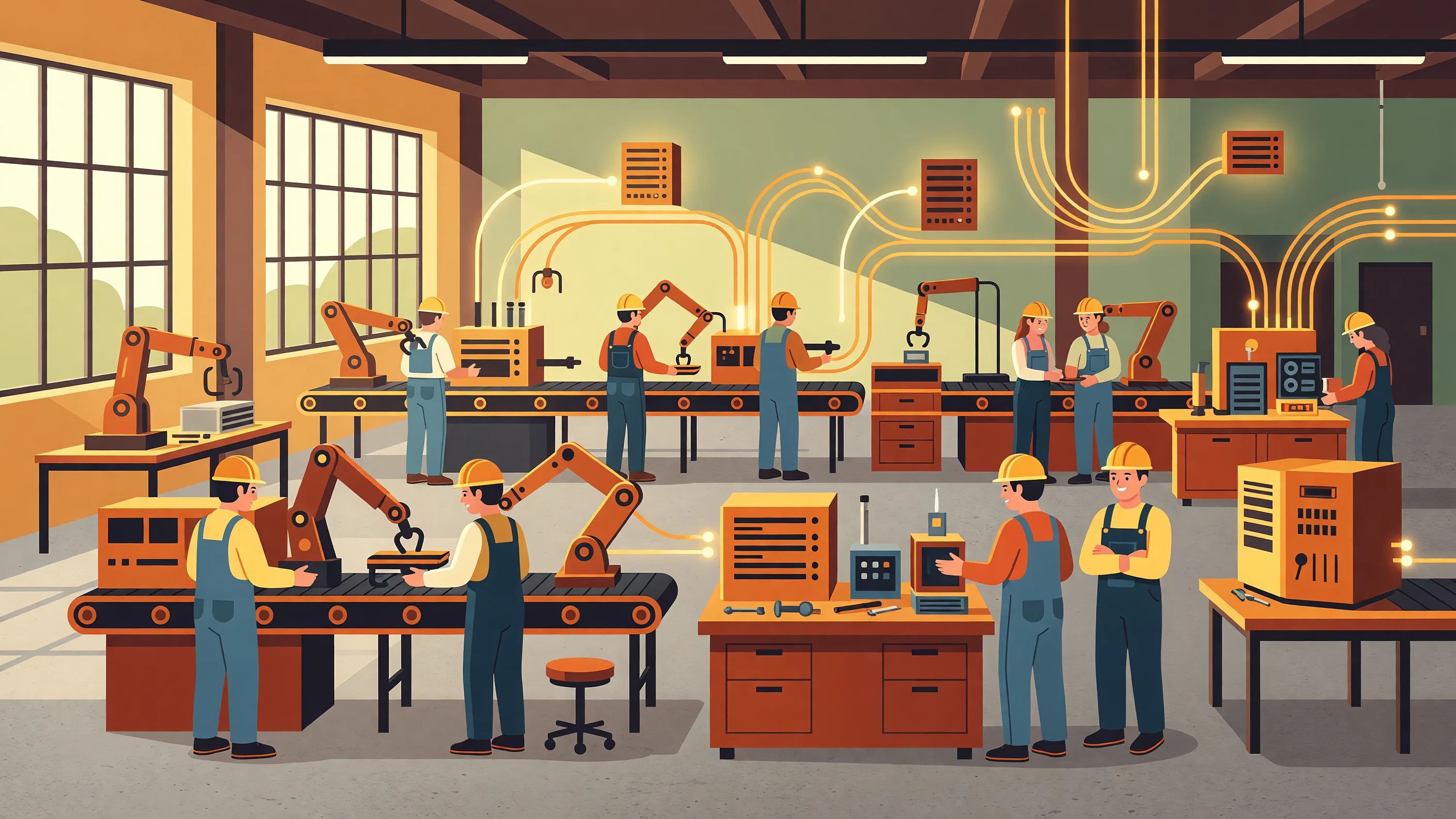
Regional Calls: A Need for Autonomy in the Manufacturing Industry
The industrial vitality of Quebec relies heavily on the strength of its regional manufacturers. Recently, as reported by TVA Nouvelles, manufacturing groups from Mauricie and Centre-du-Québec expressed a clear demand: the creation of a provincial ministry specifically dedicated to the manufacturing sector. This demand reflects a deep-seated desire to structure government support around critical challenges such as labour shortages, logistics optimization, and the digital transition. Meanwhile, during consultations held by the Table des MRC du Centre-du-Québec and reported by ICI Radio-Canada, economic development and the attractiveness of local living environments were identified as priority areas ahead of the next democratic milestones.
Behind these political calls lies a pressing operational reality. To remain competitive against international players, local manufacturers must accelerate their technological transition. Integrating artificial intelligence into manufacturing processes, inventory management, or predictive maintenance is no longer a matter of science fiction, but a current economic necessity. However, this modernization faces a major hurdle that local stakeholders cannot ignore: the security and integrity of their highly strategic data.
The Digital Transition Dilemma: Innovation Versus Intellectual Property
For a manufacturer, core value lies in proprietary manufacturing secrets, engineering blueprints, technical specifications, and chemical formulas. The widespread adoption of consumer artificial intelligence services poses a major systemic risk of data leaks. When employees upload confidential technical documents to tools hosted abroad by tech giants, this strategic information crosses borders and is integrated into the training cycles of global models, escaping the control of the originating organization. Furthermore, Quebec's stringent Law 25 on personal information protection imposes strict rules regarding where data is hosted and processed.
To overcome this obstacle, the industrial sector must adopt cutting-edge technologies capable of extracting value from internal documentation while maintaining complete data isolation. Finding solutions requires understanding two fundamental scientific mechanisms: Retrieval-Augmented Generation (RAG) and embeddings.
Local Semantic Search: Decoding RAG and Embeddings
To effectively leverage complex maintenance manuals or production history without training a costly AI model from scratch, engineers rely on the RAG technique. Unlike a standard language model that attempts to predict the next word based on general knowledge, a RAG architecture first searches for relevant excerpts directly within the organization's own library before generating a response. To achieve this, source documents are broken down and converted into numerical vectors, a process known as generating embeddings.
These vectors act like geographic coordinates in a conceptual space: two sentences sharing the same meaning will be located close to each other, regardless of the exact words used. This method allows a plant operator to query an AI system in natural language and instantly retrieve the exact procedure for repairing a specific machine, validated by internal engineering sheets. The challenge lies in deploying this processing power directly at the factory level, without relying on centralized cloud infrastructures located outside our borders.
A Sovereign and Integrated Solution: Local Architecture Serving the Field
This is precisely where the intersection of sovereignty and automation makes the Quebec technology stack so relevant. The ProductivIA application intelligence platform enables regional manufacturers to structure their technical knowledge using the Document Library application. By natively integrating RAG technology, the Document Library application converts complex specifications and industrial blueprints into an accessible corporate memory using natural language, all while ensuring no data ever leaves the organization.
This isolation is made possible by integrating Matania, a large language model provider hosted exclusively in Quebec. By configuring the ProductivIA orchestrator to route queries to Matania, a manufacturing administrator ensures that no proprietary secrets transit through infrastructures subject to extraterritorial laws like the US Cloud Act. The entire analysis, evaluation, and generation process runs in a closed loop, strictly meeting the compliance standards of Law 25.
Furthermore, this sovereign approach can be reinforced right down to the company's hardware foundations. By deploying Boréal-OS, a native operating system designed in Quebec, manufacturers can extend the useful life of workshop computers deemed obsolete by Windows 11 hardware requirements. This approach not only reduces electronic waste and the cost of purchasing new hardware, but also guarantees a clean workstation free of invasive commercial telemetry. Employees can then securely access ProductivIA directly from their web browser, benefiting from an entirely sovereign hardware and software stack.
Future Outlook: Toward a Resilient and Decentralized Industrial Model
As regions call for increased support to structure their economic growth, the resilience of our industrial SMEs will depend on their ability to control their digital production tools. Adopting a technological framework that combines an eco-responsible operating system, a no-code application suite, and a local intelligence engine outlines the future of a modern, autonomous industry that respects its own intellectual resources. By leveraging these regional, sovereign innovations, manufacturers in Centre-du-Québec and Mauricie now have practical tools to turn their historical expertise into a sustainable competitive advantage, shielded from global technopolitical disruptions.