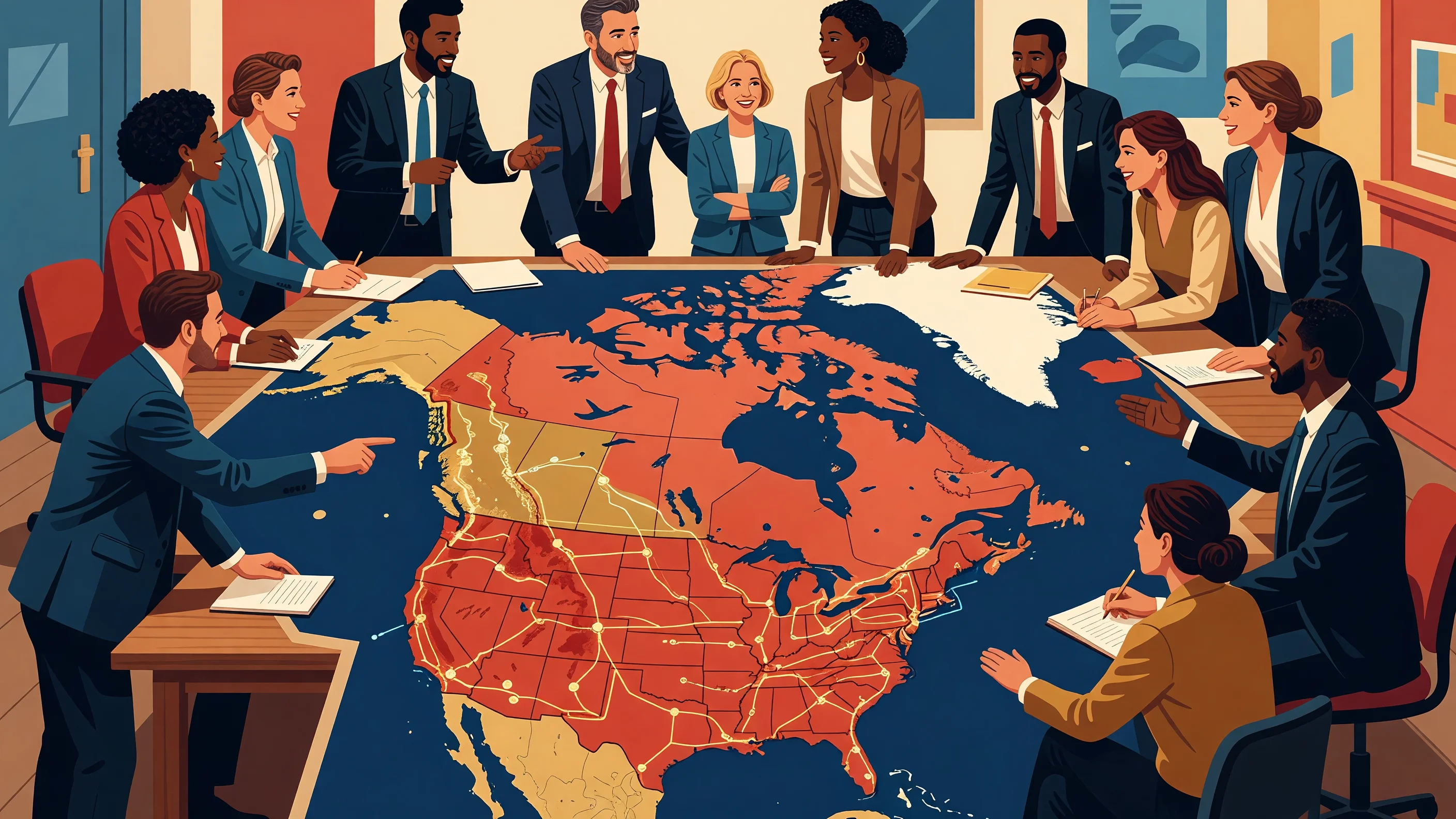
The Shockwave of Cross-Border Tariffs
In August 2026, the announcement of new tariffs unilaterally imposed by the US administration on Canada sent a chill through economic circles. Beyond the immediate financial impact on supply chains, it is the extreme legal uncertainty that now worries analysts. According to reports by Radio-Canada, many experts doubt the constitutional and international legality of these measures, particularly regarding the Canada-United States-Mexico Agreement (CUSMA).
Le Nouvelliste also points out that these unilateral decisions are raising sharp legal challenges within the United States itself, where the scope of the president's emergency economic powers is the subject of fierce debate. For Quebec businesses, this situation represents not only a potential increase in customs costs, but also a highly complex contractual headache. Every organization must urgently assess its risk exposure to maintain operational viability.
The Contractual Challenge: Deciphering Unpredictability
Faced with this regulatory instability, legal and procurement departments must comb through thousands of pages of supply contracts and partnership agreements. The challenge lies in determining which contracting party must bear the burden of the new customs duties. To do this, they must carefully analyze force majeure, hardship, or risk-transfer (Incoterms) clauses.
This reassessment must be carried out very quickly to avoid supply disruptions or costly commercial disputes. In this race against time, integrating artificial intelligence technologies to accelerate document analysis is becoming essential. However, using public consumer language models hosted abroad poses a major risk. Sending confidential supply contracts, which contain strategic price lists and exclusivity clauses, to servers located outside national borders exposes organizations to industrial espionage risks and the application of extraterritorial laws like the US Cloud Act.
Combining RAG and a Sovereign LLM to Secure Compliance
The ProductivIA application orchestration platform offers a rigorous technical response to this need for regulatory resilience through its Document Library application. This application leverages RAG (Retrieval-Augmented Generation) technology. Instead of submitting an entire, voluminous contract to an AI model, the Document Library first converts files into vector representations called embeddings.
When a legal advisor or procurement manager asks a specific question, such as: "What is the mechanism for allocating unforeseen import taxes in our transport contracts?", the system identifies and extracts only the relevant paragraphs. These targeted text segments are then sent to the language model to generate an evidence-based response grounded exclusively in the company's actual documents, drastically reducing the risk of hallucinations.
To guarantee that these highly strategic analyses remain entirely confidential, the ProductivIA platform relies on Matania, the Quebec-hosted sovereign language model provider. User queries never cross national borders, eliminating any risk of cross-border interception and ensuring full compliance with Law 25 requirements on the protection of personal information. The corporate silo administrator can thus route all contract analysis queries to Matania's Quebec infrastructure without changing the user interface.
A Transition Toward Operational Autonomy
Thanks to ProductivIA's entirely no-code philosophy, this secure, automated audit capability is placed directly in the hands of operations and compliance professionals, without requiring programming skills. The platform's closed and compartmentalized architecture protects the most sensitive trade secrets against data leaks. Faced with the arbitrary nature of cross-border tariff decisions, technological sovereignty is no longer just an ethical issue: it has become an essential shield to preserve business continuity and the legal security of local companies.