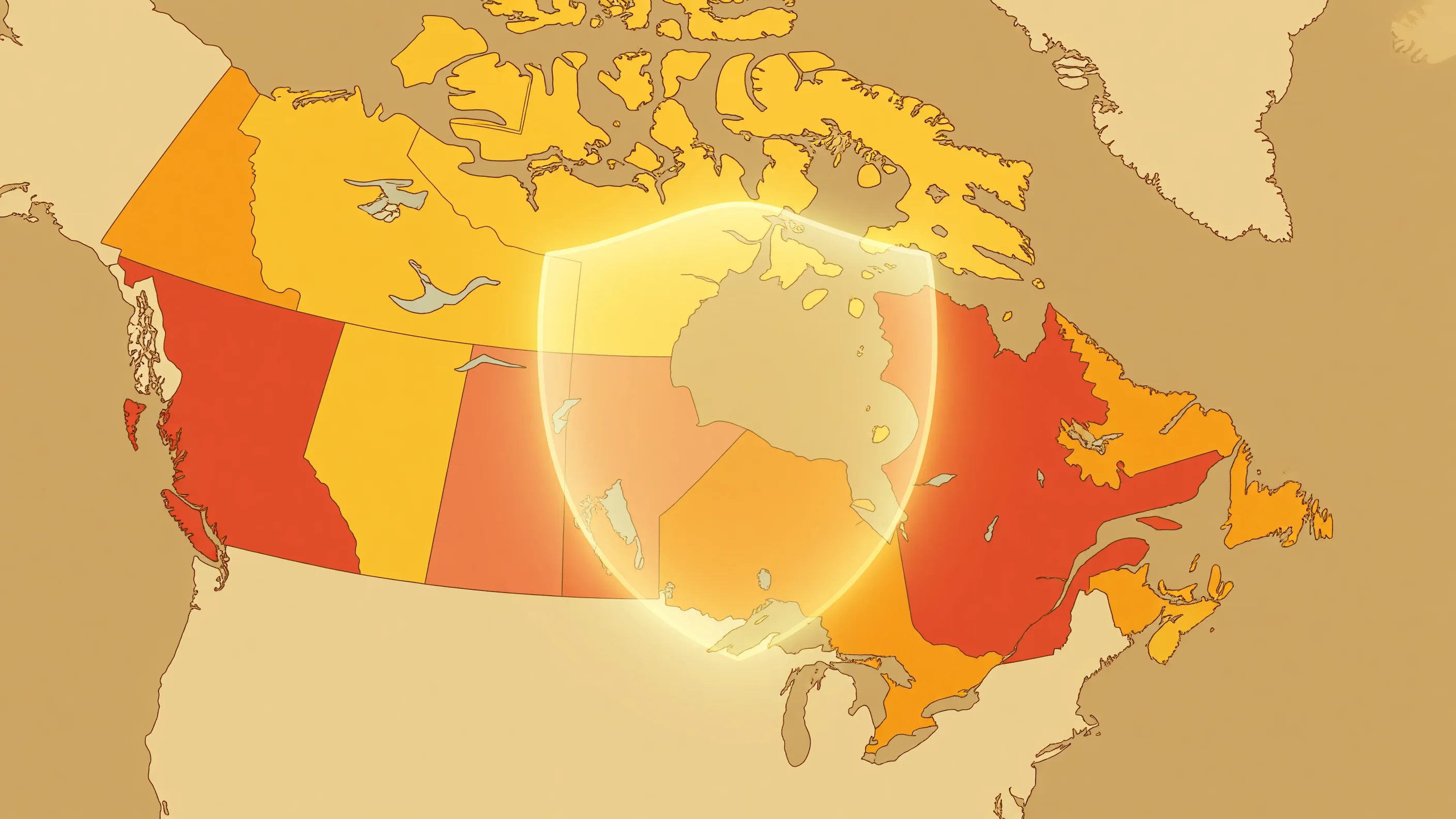
The Tariff Shock and the Invisible Supply Chain
The recent signing by US President Donald Trump of an executive order imposing 50% tariffs on a wide range of Canadian products has sent a major economic shockwave through the country. Political reactions were swift, with several elected officials denouncing the move as a direct violation of the Canada-United States-Mexico Agreement (CUSMA). As tariff barriers rise on physical goods, the vulnerability of our digital infrastructure to unilateral foreign decisions is becoming a critical issue for economic security.
This trade crisis highlights an often overlooked dependency: our reliance on foreign data flows and daily productivity tools. While cement, aluminum, or dairy products make the headlines, the software supply chain of Canadian and Quebec businesses and institutions also relies heavily on infrastructure located outside our borders. A foreign political decision, whether in the form of a digital tax, a technology export restriction, or a unilateral legislative change, can paralyze entire sectors of our administrative economy overnight.
The Fragility of Cross-Border Digital Dependencies
To understand the scope of this vulnerability, we must analyze the current architecture of cloud services and artificial intelligence. The vast majority of Canadian organizations entrust their data to servers located in the United States or managed by companies subject to US laws, such as the CLOUD Act or Section 702 of the Foreign Intelligence Surveillance Act (FISA). According to analyses by the Canadian Centre for Cyber Security, this centralization exposes national data to risks of legal exfiltration or service disruption in the event of a geopolitical conflict.
The field of generative artificial intelligence heightens this risk. State-of-the-art large language models (LLMs) are almost exclusively controlled by a small number of American providers. If these providers decide to restrict access to their application programming interfaces (APIs) for reasons of national security or economic protectionism, local businesses would find themselves deprived of their essential work tools. Recent history has already shown that export restrictions can be applied unilaterally to advanced AI technologies, forcing international organizations to urgently overhaul their operational processes.
The Sovereign Alternative: The Matania Model and the Nuage Application
Faced with these geopolitical uncertainties, the Quebec-based platform ProductivIA offers an approach focused on resilience and data containment. Rather than linking organizational operations to unstable foreign infrastructure, the platform's architecture allows all artificial intelligence processing to be shifted to local solutions.
At the heart of this sovereign fallback strategy is Matania, the language model provider physically hosted in Quebec. When a public institution or business configures its tools on the ProductivIA platform, it can choose to route its queries exclusively to Matania's servers. Sensitive data never crosses the border, remaining safe from extraterritorial laws and unilateral trade sanctions. This intelligent orchestration mechanism guarantees business continuity, regardless of ongoing diplomatic tensions.
At the same time, ProductivIA's Nuage application offers complete transparency regarding information storage. Unlike proprietary solutions where file location and processing remain opaque, Nuage allows administrators to view, control, and export all data stored within their logical silo. This strict compartmentalization ensures rigorous compliance with Quebec's Law 25 on the protection of personal information, while eliminating the risk of vendor lock-in.
An Autonomous Technology Stack for Global Security
However, digital sovereignty cannot be limited to the application layer. To provide comprehensive protection against external uncertainties, the Quebec ecosystem offers a three-tiered response. While ProductivIA manages the workspace in the browser and Matania provides local intelligence, the native operating system Boreal-OS completes this stack by securing the hardware itself. By replacing commercial operating systems subject to constant telemetry and forced obsolescence, this sovereign Linux distribution restores control of physical machines to local organizations.
This complementarity demonstrates that a viable and robust alternative exists to counter the vulnerability of our cross-border dependencies. By choosing tools designed, hosted, and governed locally, Canadian and Quebec organizations are not just choosing data security: they are ensuring that their daily operations will never be held hostage by foreign political decisions.
Looking Ahead
As trade tensions force a redefinition of global economic alliances, local organizations must ask themselves a fundamental question: what is the true value of operational continuity when our most essential work tools depend on the goodwill of a foreign government? The transition to sovereign infrastructure is no longer solely a technical or legal consideration, but a strategic national security decision.