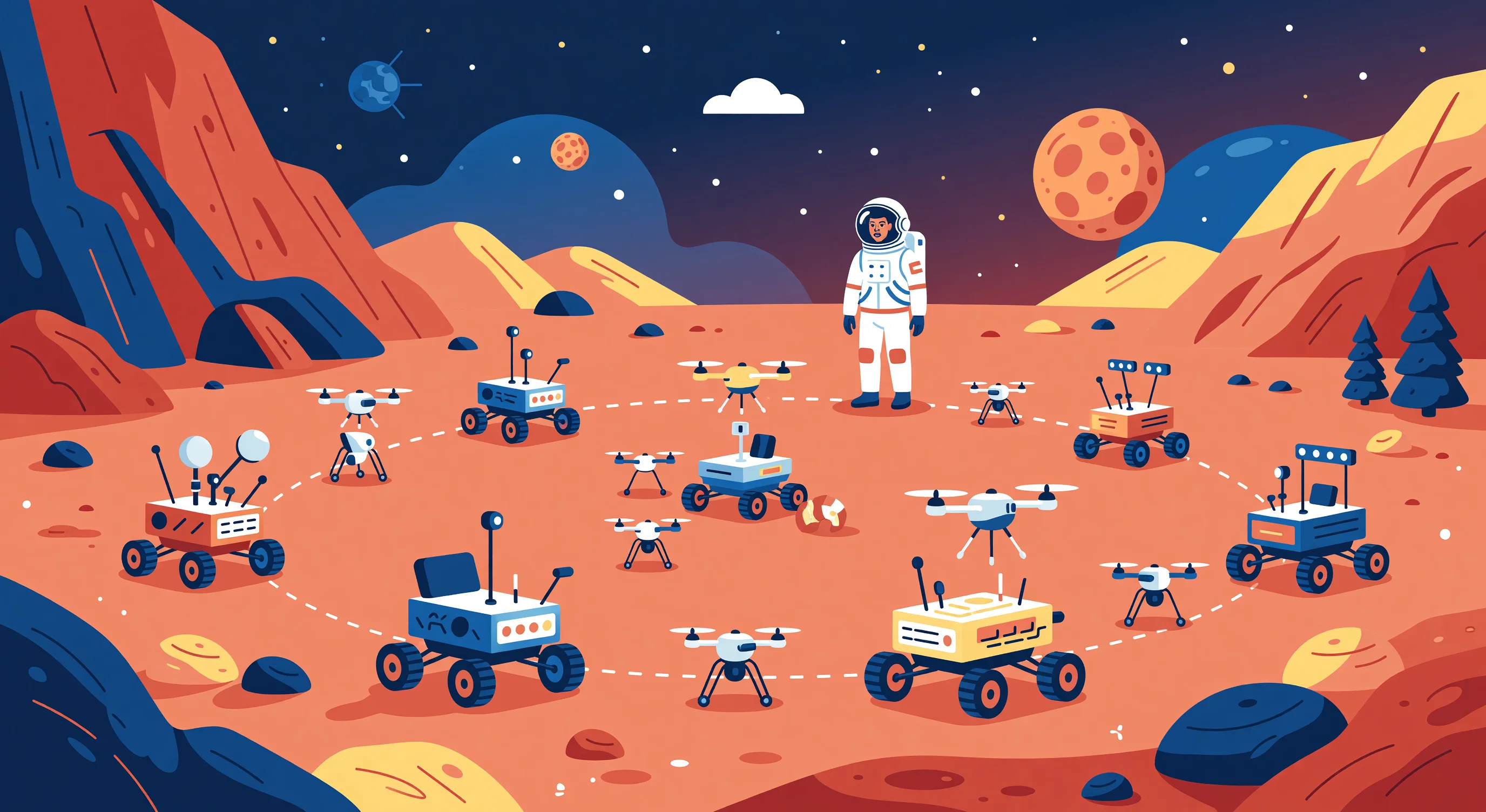
Space exploration is taking a decisive step forward. The National Aeronautics and Space Administration (NASA) recently revealed details of its roadmap for establishing a permanent base at the Moon's South Pole. Far from the classic depiction of a single, isolated dome, this major project is planned to span several hundred square kilometres. To orchestrate and maintain such an infrastructure without relying on a constant human presence, the American agency is betting on a specific technological approach: deploying a multitude of autonomous, specialized, and interconnected robotic agents.
The Choice of Decentralization: Resilience Through the Swarm
According to information published by New Scientist magazine and confirmed by recent NASA press releases, several preparatory missions are scheduled to launch to map the terrain and test survival technologies in hostile environments. At the heart of this strategy is a categorical rejection of the monolithic model. Rather than designing a single, gigantic, and omnipotent rover, NASA is prioritizing a swarm of complementary machines: payload landers, jumping drones capable of crossing crevices, transport vehicles, and autonomous micro-rovers.
This choice is based on a fundamental engineering principle: resilience through the distribution of tasks. In the hostile environment of the Moon, where temperatures fluctuate extremely and radiation constantly threatens electronics, the failure of a centralized system would mean the total loss of the mission. By distributing responsibilities among several autonomous agents, the loss of a single unit does not hinder the overall operation of the network. Furthermore, each robot is optimized for a single task (drilling, mapping, transport), which reduces its software complexity and increases its energy efficiency.
From the Cosmos to Servers: The Philosophy of Composability
This design philosophy is not limited to space robotics; it is now emerging as a major paradigm in the architecture of terrestrial information systems. Public and private organizations face a challenge similar to NASA's: managing a complex, changing, and disruption-prone data environment while avoiding single points of failure. This is where the concepts of composable architecture and agentic artificial intelligence (Agentic AI) come into play.
For decades, the software industry favoured monolithic systems: large, centralized applications attempting to handle everything from databases to user interfaces and calculation engines. However, these massive structures prove to be rigid, difficult to update, and vulnerable to security flaws. Conversely, the multi-agent approach proposes dividing the work among several autonomous software entities, each an expert in its domain, which collaborate to achieve a common goal without ever overloading the central system.
The ProductivIA Approach: The Assistant as Orchestrator
The Quebec-based platform ProductivIA embodies this transition toward software composability. Rather than offering a single, massive artificial intelligence model to process all requests indiscriminately, an approach often prone to hallucinations and highly resource intensive, the platform's architecture relies on an ecosystem of specialized, independent applications.
At the centre of this setup, the Assistant application acts as the platform's coordinator. Much like the NASA control centre supervising lunar operations, the Assistant does not execute all storage, calculation, or writing tasks itself. It relies on a standardized protocol named assistant_services to call upon dedicated applications.
For example, when a user asks to analyze a financial report or draft an official document, the Assistant does not attempt to store or process the file directly. It calls on the Nuage application to access the data seamlessly, then queries the Base documentaire to perform a semantic search using RAG (Retrieval-Augmented Generation). Each application retains its autonomy, security rules, and isolation, ensuring that organizational data remains partitioned, auditable, and compliant with Law 25 requirements.
Increased Resilience in the Face of Technological Fluctuations
This modularity offers essential flexibility in the face of rapid technological developments. If a specific language model fails or its performance fluctuates, a phenomenon documented by researchers at Stanford and Berkeley universities, the system administrator can redirect queries to another provider, such as the sovereign Quebec model Matania, without having to rewrite the application code. The data, meanwhile, remains secure within the organization's silo, visible only through the Nuage application, excluding any unauthorized transfer abroad.
NASA's initiative demonstrates that complexity is better managed through the collaboration of simple, specialized modules than through excessive centralization. As institutions and businesses must modernize their infrastructures while adopting artificial intelligence, the transition to multi-agent and no-code architectures appears to be a pragmatic and secure path.
Going Further
The rise of multi-agent systems raises the question of standardizing communication protocols between machines. As organizations deploy fleets of virtual assistants and automated tools, the ability of these agents to collaborate seamlessly and securely, without constant human intervention, will become the primary driver of productivity. Governance frameworks will need to adapt to precisely define the boundaries of responsibility for each digital agent within collective infrastructures.