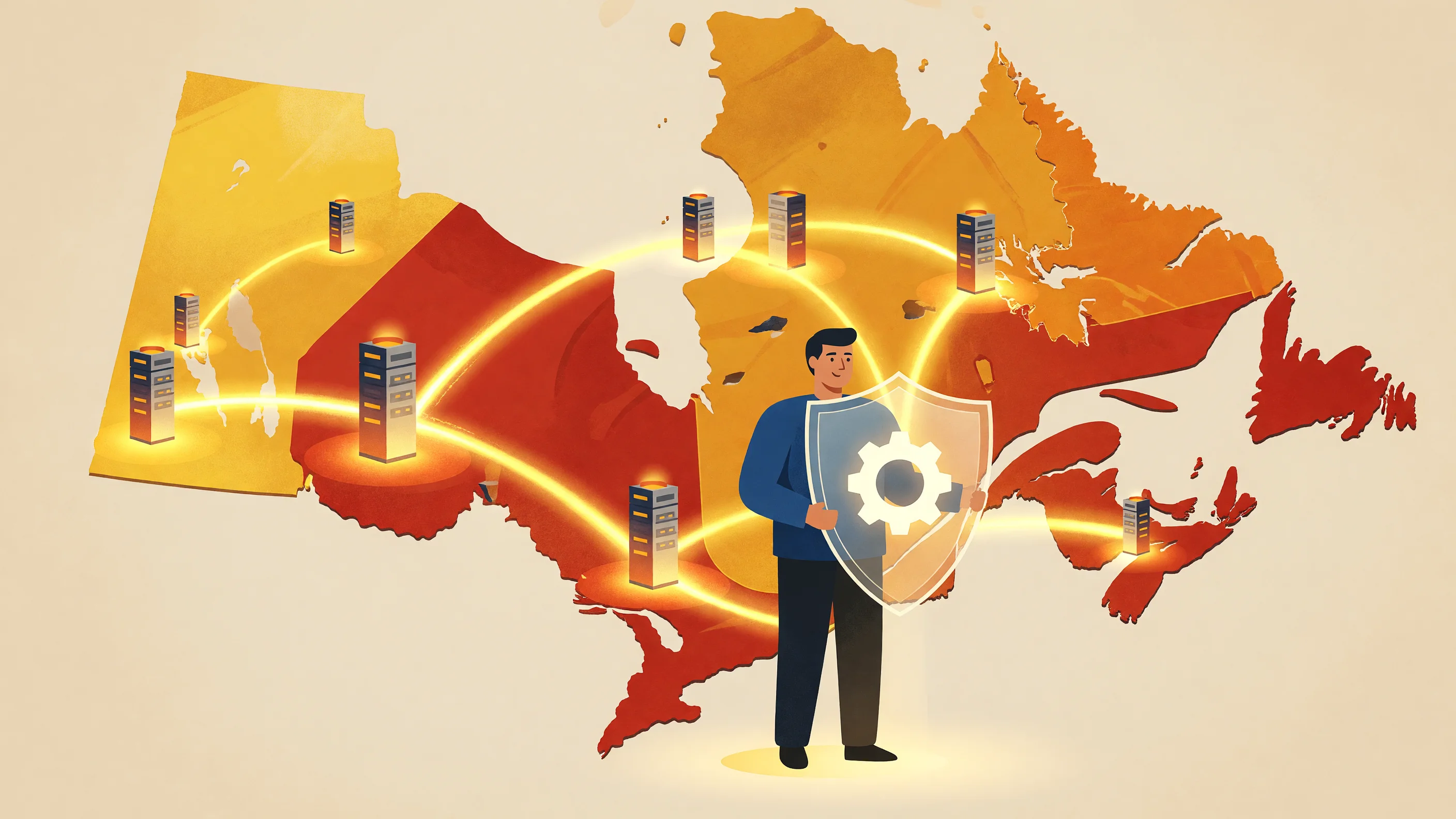
Quebec's Legislative Leadership and the Tech Giants
Quebec has positioned itself as a pioneer in North America for personal information protection. With the gradual phase-in of the Act to modernize legislative provisions as regards the protection of personal information, commonly known as Law 25, the province has moved ahead of Canadian federal regulatory frameworks, aligning closely with the rigorous standards of the European Union's General Data Protection Regulation (GDPR). While federal Bill C-27 and its Artificial Intelligence and Data Act (AIDA) are still being debated in Ottawa, Quebec organizations must already comply with strict, immediately applicable legal obligations.
This legislative head start creates a sharp contrast between local compliance requirements and the practices of major global technology providers. According to the Commission d'accès à l'information du Québec, businesses and public institutions are now responsible for guaranteeing the transparency of automated decisions, ensuring data portability, and strictly limiting the collection of personal information to what is necessary. For local managers, the question is no longer whether to adopt artificial intelligence, but how to integrate it without breaking the law.
The Puzzle of AI and Cross-Border Data Transit
The main point of friction between Law 25 and mainstream artificial intelligence tools lies in data transit. The vast majority of popular large language models (LLMs) are operated by American companies with servers located outside Quebec and Canada. However, Law 25 imposes a clear obligation: before communicating personal information outside the province, an organization must conduct a privacy impact assessment (PIA). This assessment must demonstrate that the information will receive adequate protection, in compliance with the principles of Quebec law.
In practice, auditing the data flows of a centralized AI provider is extremely complex. Queries sent to these services often transit through international networks and can be used, more or less explicitly, to retrain third-party models. As ProductivIA has documented in previous analyses, exclusive reliance on foreign infrastructure exposes organizations to risks of unilateral service disruption or unpredictable changes to privacy policies. In the face of this legal and technical uncertainty, centralizing data with non-sovereign third parties becomes a major operational risk.
An Architectural Solution: Quebec's Sovereign Ecosystem
To meet the requirements of Law 25 without sacrificing the productivity gains offered by artificial intelligence, organizations must turn to architectures designed natively for compliance. This is precisely where the complementary nature of a local technology ecosystem makes sense. Rather than trying to adapt foreign tools to local standards, the solution is to use a technology stack that integrates these constraints from the ground up.
The ProductivIA platform addresses this challenge with a secure, multi-silo architecture. Unlike traditional cloud solutions where all user data is merged into large centralized databases, ProductivIA compartmentalizes information within logical silos specific to each organization. The Nuage application, which serves as a transparent storage manager, allows administrators to see in real time where files are stored and to export them fully at any time, directly addressing the right to data portability under Law 25.
At the artificial intelligence level, this secure compartmentalization is completed by the integration of the sovereign model provider Matania. Physically hosted in Quebec, Matania runs high-performance language models based on the Qwen family without a single query crossing the border. The platform orchestrator can be configured to route sensitive data flows exclusively to these local servers. Student records, medical data, or confidential legal documents are thus processed within a stable and verifiable legal framework, eliminating the need for complex cross-border privacy impact assessments.
Global Sovereignty, From Hardware to Application
Alignment with Law 25 requirements is not limited to the application layer. A true compliance and security strategy must also consider the operating system of the user's machine. Modern commercial operating systems integrate numerous telemetry and usage data collection mechanisms that often escape the control of IT administrators.
This is where Boréal-OS, Quebec's sovereign Linux distribution, completes the technology stack. By installing Boréal-OS on workstations, organizations free themselves from software surveillance and extend the lifespan of their hardware by several years. Once this secure operating system is in place, the ProductivIA platform is accessed simply through the browser, offering a fully sovereign workstation, from the physical machine to the AI applications.
Ultimately, Quebec's legislative leadership should not be seen as a barrier to innovation, but as a catalyst for developing a more ethical, transparent, and resilient local technology industry. By choosing solutions designed to respect our laws, local organizations secure long-term digital autonomy, shielded from international geopolitical and regulatory turbulence.