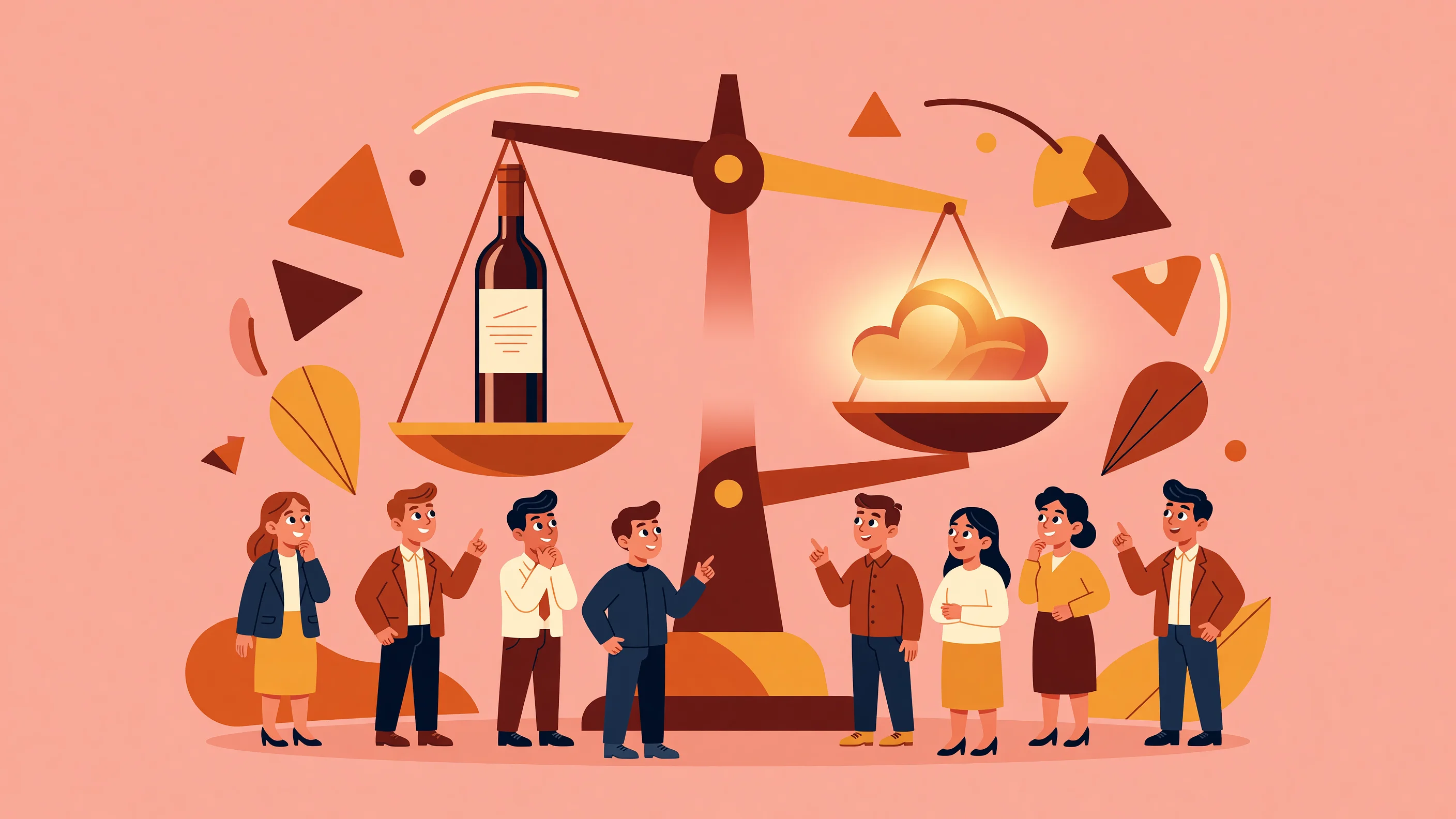
The Real Economy Held Hostage by Digital Taxation
The recent G7 summit in Évian-les-Bains was the scene of a striking illustration of modern geopolitical tensions. As world leaders gathered to address collective security issues, US President Donald Trump reiterated his threats to impose tariffs of up to 100% on French wines, champagnes, and spirits. This direct retaliatory measure aims to force Paris to abandon its digital services tax, commonly known as the GAFA tax.
This trade conflict highlights a mechanism of asymmetric coercion: to protect the hegemony of its tech giants, an economic superpower does not hesitate to hold hostage the traditional and flourishing sectors of a third country's real economy. French winemakers, heavily dependent on the American market, find themselves on the front lines of a war in which they control none of the parameters. Beyond a simple tariff dispute, this episode reveals the depth of our collective dependence on foreign digital infrastructure.
The Mechanisms of Technological Asymmetry
The French digital services tax, introduced to address loopholes in the international tax system, targets companies with global revenues of over 750 million euros, a significant portion of which is generated in French territory. According to analyses by the French Ministry of Economy and Finance, this measure aims to restore tax fairness against multinationals that optimize their profits by exploiting physical borders. In response, the Office of the United States Trade Representative (USTR) initiated investigations under Section 301 of its Trade Act, calling the tax discriminatory against Silicon Valley flagships.
This dynamic demonstrates that control over information technology is not merely a matter of convenience or corporate productivity; it is a lever of state power. When a state attempts to regulate or tax digital platforms operating on its soil, it faces direct economic retaliation. According to reports from the Organisation for Economic Co-operation and Development (OECD) on digital taxation, the lack of a harmonized multilateral framework exposes sovereign nations to unilateral retaliatory measures, weakening their decision-making autonomy.
The Quebec Response: Three-Tiered Technological Autonomy
Faced with this systemic vulnerability, true sovereignty cannot be negotiated solely through tax treaties; it must be built into the infrastructure itself. Quebec's sovereign ecosystem offers a concrete alternative to this dependency by structuring a rigorous response across three complementary levels: hardware, the application environment, and artificial intelligence.
At the first level, the native operating system Boréal-OS makes it possible to break free from dependency on obsolescence cycles imposed by major proprietary software vendors. By giving a second life to existing IT hardware, it ensures essential hardware independence for local institutions and businesses.
At the second level, the ProductivIA application platform runs directly in the browser, offering a complete work environment without requiring heavy local installations or unmanaged external software dependencies. It is at this level that key resilience tools such as the Nuage application and the AI Comparator are deployed:
- The Nuage application guarantees total transparency and absolute data portability. Unlike solutions from American hyperscalers subject to extraterritorial legislation such as the CLOUD Act, Nuage keeps all files and interactions within the organization's silo, ensuring natural compliance with the requirements of Quebec's Law 25.
- The AI Comparator allows organizations to orchestrate and compare the performance of different language models in real time. If a foreign provider becomes inaccessible or presents a compliance risk, the organization can instantly switch its workflows to other engines, notably to the sovereign Matania model, hosted locally in Quebec, without changing a single line of application code.
This multi-silo and modular architecture neutralizes the risk of vendor lock-in. In the event of a geopolitical crisis or economic blackmail, an organization using this sovereign stack retains full control over its production tools and data.
Toward Collective Digital Resilience
The standoff over the GAFA tax is a reminder that technological dependency is a major political vulnerability. For public and private organizations, transitioning to sovereign solutions is no longer just an ethical choice, but an essential risk management strategy. By combining an operating system free of any telemetry, a standardized no-code application environment, and locally hosted artificial intelligence models, Quebec is paving the way for a dignified and resilient computing model capable of withstanding the turbulence of international markets.