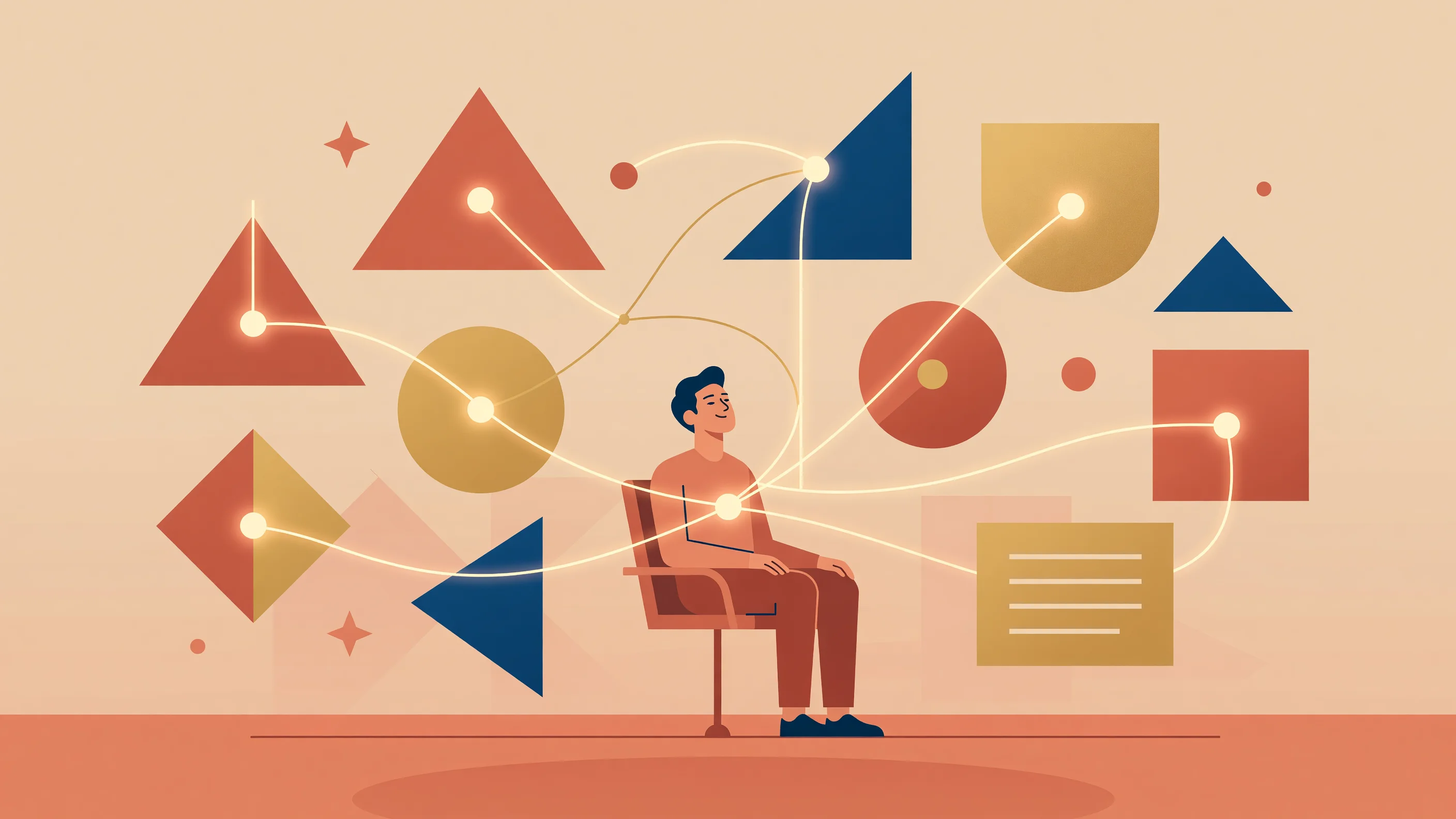
Moving Beyond the Chat Window
The era of simply typing a prompt into an empty chat window is coming to an end. Major artificial intelligence developers are currently making a major strategic shift, moving away from the single chatbot model toward unified work environments, often referred to as workbenches or integrated workspaces. Anthropic's recent announcement of its new product, Claude Science, fits perfectly into this trend. Designed specifically for researchers and scientists, this tool is no longer a simple chat interface, but a true digital laboratory that brings together specialized databases, computational pipelines, and analytical tools within a single space.
This transition toward complete application environments addresses an obvious limitation of current language models: when used in isolation, they impose a high cognitive load on users, who are forced to constantly copy and paste between their various software programs and the AI window. To become a true driver of productivity, artificial intelligence must integrate directly into the workflow, access relevant documents, and be capable of executing complex actions autonomously.
The Rise of Agentic AI and RAG
To understand this evolution, it is helpful to explain two key concepts redefining human-computer interaction: agentic AI and Retrieval-Augmented Generation (RAG).
Unlike early conversational agents that passively responded to instructions, agentic AI refers to systems capable of planning complex tasks, using external tools, and correcting their own errors along the way. According to an analysis published by the research firm Gartner, agentic AI is one of the top strategic technology trends for the coming years, marking the transition from assistive AI to agentic execution.
To act effectively, these agents need to be anchored in the real world. This is where RAG comes in. Rather than constantly retraining a language model with new data, which is an extremely costly and energy-intensive process, RAG extracts relevant information fragments from a local document database and injects them directly into the model's context at the moment of the query. This technique relies on embeddings, which are vector representations that translate the semantic meaning of a text into mathematical coordinates. Two sentences with similar meanings will have close vectors, allowing for much more effective conceptual searches than simple keyword queries. RAG anchors the AI's answers in verifiable sources, drastically reducing the risk of hallucination.
The Risks of Centralization and the Sovereign Response
This transition toward integrated workspaces nevertheless poses a major challenge: technological dependency and data sovereignty. Recent events have highlighted the vulnerability of centralized infrastructures. The temporary suspension and subsequent reinstatement of Anthropic's Fable 5 and Mythos 5 models, triggered by export controls imposed by the US Department of Commerce, demonstrate that organizations entrusting their entire business processes to a single provider expose themselves to unilateral geopolitical decisions.
Furthermore, for public institutions and Quebec businesses subject to Law 25 on the protection of personal information, using these integrated foreign platforms often involves the cross-border transfer of sensitive data to servers subject to extraterritorial laws, such as the US CLOUD Act. As the Commission d'accès à l'information du Québec points out, any transfer of personal information outside the province requires a rigorous privacy impact assessment, a requirement that is difficult to reconcile with opaque proprietary solutions.
ProductivIA's Virtual OS Architecture
It is precisely to meet this dual requirement of application integration and sovereignty that the ProductivIA platform was designed. Rather than offering yet another closed chat tool, ProductivIA operates as a virtual operating system running directly in the user's browser.
At the heart of this architecture is the Assistant application, which acts as a central orchestrator. Thanks to the standardized assistant_services protocol, the Assistant can communicate seamlessly with all other applications on the platform. For example, it can query the Base documentaire application to perform a semantic search based on RAG, use the results to draft a summary document in the Doc application, and then prepare a draft response in the Courriel application. The user thus benefits from a unified and fluid workspace, without requiring a single line of code.
This modular approach offers total flexibility. Unlike proprietary solutions like Claude Science, which lock the user into a single ecosystem of models, ProductivIA's orchestration layer allows for instant switching from one AI provider to another. A silo administrator can configure the platform to use models from OpenAI or Anthropic for general tasks, while routing queries containing highly sensitive data to the sovereign Quebec model Matania, hosted locally in Quebec. Data remains protected, confined within the organization's silo, and transparently visible through the Nuage application.
Toward Cloud-Based and Sustainable Computing
The trend toward unified workspaces shows that the computer of tomorrow will no longer be defined by the software installed locally on its hard drive, but by its ability to access a secure, intelligent, virtual work environment. This software dematerialization aligns perfectly with the demands of digital sobriety. By combining a lightweight, sovereign operating system installed on the machine, such as Boréal-OS, which extends the useful life of computers declared obsolete by Windows 11 hardware requirements, with an application environment like ProductivIA in the browser, organizations can modernize their IT infrastructure without giving in to electronic waste or compromising data security.