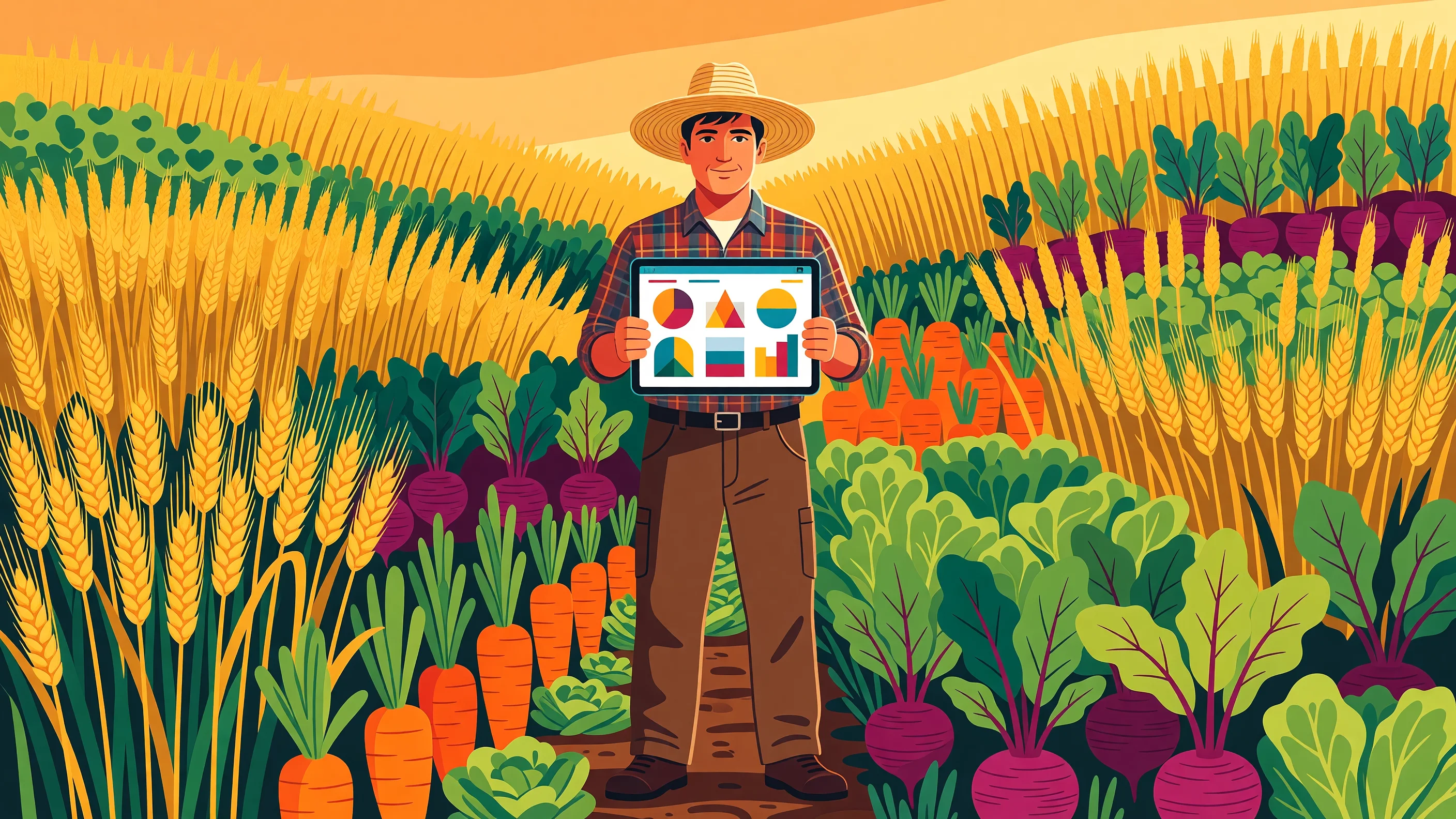
When Food Sovereignty Requires Digital Sovereignty
Modern agriculture is undergoing an unprecedented technological transition. According to an analysis published by the scientific portal Phys.org, the global market for artificial intelligence applied to agriculture is expected to reach nearly 47 billion US dollars by 2034. While this promise of optimizing yields in the face of climate change and resource scarcity is appealing, it hides a more complex reality: to be truly effective, artificial intelligence cannot be one-size-fits-all. It must adapt to the local specificities of each unique terroir.
In Canada, and particularly in Quebec, agricultural producers face unique agronomic challenges. Temperature variations, the soil composition of the St. Lawrence Valley, and regional crop cycles differ greatly from the standardized models developed in Silicon Valley. Importing AI solutions designed for Californian mega-farms often proves unsuitable or even counterproductive. For AI to deliver on its promises, regionalizing the technology has become essential.
The Limits of Global Models and the Risk of Dependency
The adoption of AI in agriculture relies on the massive collection of data, including soil moisture levels, yield history, input use, and field mapping. When this data is processed by centralized infrastructures owned by foreign multinationals, producers face a double risk. On one hand, they lose control of highly strategic data that defines the value of their operations. On the other hand, these information flows frequently transit to servers located outside our borders, subjecting them to extraterritorial laws such as the US Cloud Act, which directly contradicts the requirements of Quebec's Law 25.
Furthermore, relying on technical intermediaries to design analytical tools creates a major financial and operational barrier for small and medium-sized agricultural businesses. Hiring specialized developers to program custom algorithms is out of reach for most producers. This is why democratizing AI in this sector requires simplified tools capable of translating agronomic expertise into concrete applications without requiring programming skills.
Demystifying the Technology: From RAG to Local Applications
To solve the challenge of local adaptation, engineers rely on techniques like Retrieval-Augmented Generation, commonly known as RAG. Unlike a generalist AI model that tries to guess an answer based on global knowledge, RAG anchors AI responses in real, local documents, such as crop protection guides from the Ministry of Agriculture, field-specific soil analyses, or regional weather histories.
This technique relies on embeddings, vector representations that allow the machine to understand the meaning of words and intelligently link an agronomist's question to the corresponding scientific data. By combining these technologies, AI stops propagating approximations and becomes a highly precise decision-making tool perfectly adapted to the realities of local fields.
The No-Code Alternative and Sovereign Hosting
It is with this focus on decentralization and autonomy that the philosophy of the ProductivIA platform is built. Thanks to its Fabrique application, agricultural producers and agronomic advisors can design their own management and analysis tools using natural language. A user can simply describe the application they need (for example, a crop rotation tracking tool based on ministry recommendations) and let the platform generate the corresponding application.
This no-code approach eliminates the need to write computer code and neutralizes the risks associated with "vibe coding" (the rapid production of code by AI without oversight). In ProductivIA, every application generated by Fabrique is confined to a secure sandbox and undergoes an automated audit before deployment. This drastically reduces the attack surface and guarantees the stability of the tool for the end user.
To complete this secure architecture, the integration of the sovereign AI engine Matania ensures that all queries and operational data remain physically hosted in Quebec. Data flows never transit through foreign infrastructure, ensuring natural compliance with Law 25 and protecting the informational assets of local agricultural businesses. By combining the simplicity of no-code with the rigor of local hosting, this sovereign ecosystem demonstrates that technology can be a driver of autonomy rather than dependency.
Toward Shared Technological Autonomy
The regionalization of AI in agriculture is not just a matter of technical efficiency; it directly affects our food and economic sovereignty. By allowing industry players to adopt these tools without intermediaries, the structured no-code model paves the way for bottom-up innovation, where solutions emerge from the field rather than being imposed by tech giants. The question remains: how will public institutions and agricultural cooperatives support this transition toward local, shared digital infrastructures?