The UNESCO Warning and the Reality of School Budgets
The recent warning from UNESCO, reported by La Presse in July 2026, highlights a concerning reality: international aid for education is experiencing a sharp decline, often sidelined by other state and budgetary priorities. This financial strain is not limited to developing countries. In Quebec and elsewhere in the West, educational institutions face a major dual challenge: maintaining high educational standards while dealing with increasingly tight infrastructure budgets.
In this climate of austerity, technological dependence on major software publishers is becoming an unsustainable financial burden. Recurring subscriptions to office suites and software upgrade requirements place constant pressure on the public finances of school boards and educational institutions. Equitable access to digital learning tools is thus directly threatened by commercial imperatives.
The Trap of Forced Hardware Obsolescence
Beyond licensing costs, the management of IT hardware itself poses a viability challenge. The announced end of support for certain widespread operating systems, coupled with strict hardware requirements for new versions (such as the mandatory presence of a TPM 2.0 chip or secure boot), threatens to make millions of perfectly functional computers obsolete. According to a study by the analysis firm Canalys, the scheduled end of life for Windows 10 could send nearly 240 million personal computers to landfills worldwide due to a lack of official compatibility with its successor.
For schools, this forced electronic waste represents an astronomical acquisition cost. Having to replace an entire IT fleet simply to meet the requirements of a commercial operating system is both an economic and ecological aberration. Furthermore, the transition to an all-cloud model exposes institutions to complex challenges regarding personal information protection. In Quebec, Law 25 imposes a very strict framework on data governance. The use of free or low-cost foreign platforms often runs into the impossibility of guaranteeing that student data is not hosted or processed outside national borders.
The search for viable alternatives, capable of reconciling budgetary sobriety, hardware durability, and legal compliance, is therefore becoming a major institutional priority.
The Sovereign Alternative: Rehabilitating Hardware and Localizing Applications
It is precisely at this intersection that Quebec's sovereign ecosystem offers a structured, multi-level approach, combining hardware rehabilitation with application autonomy.
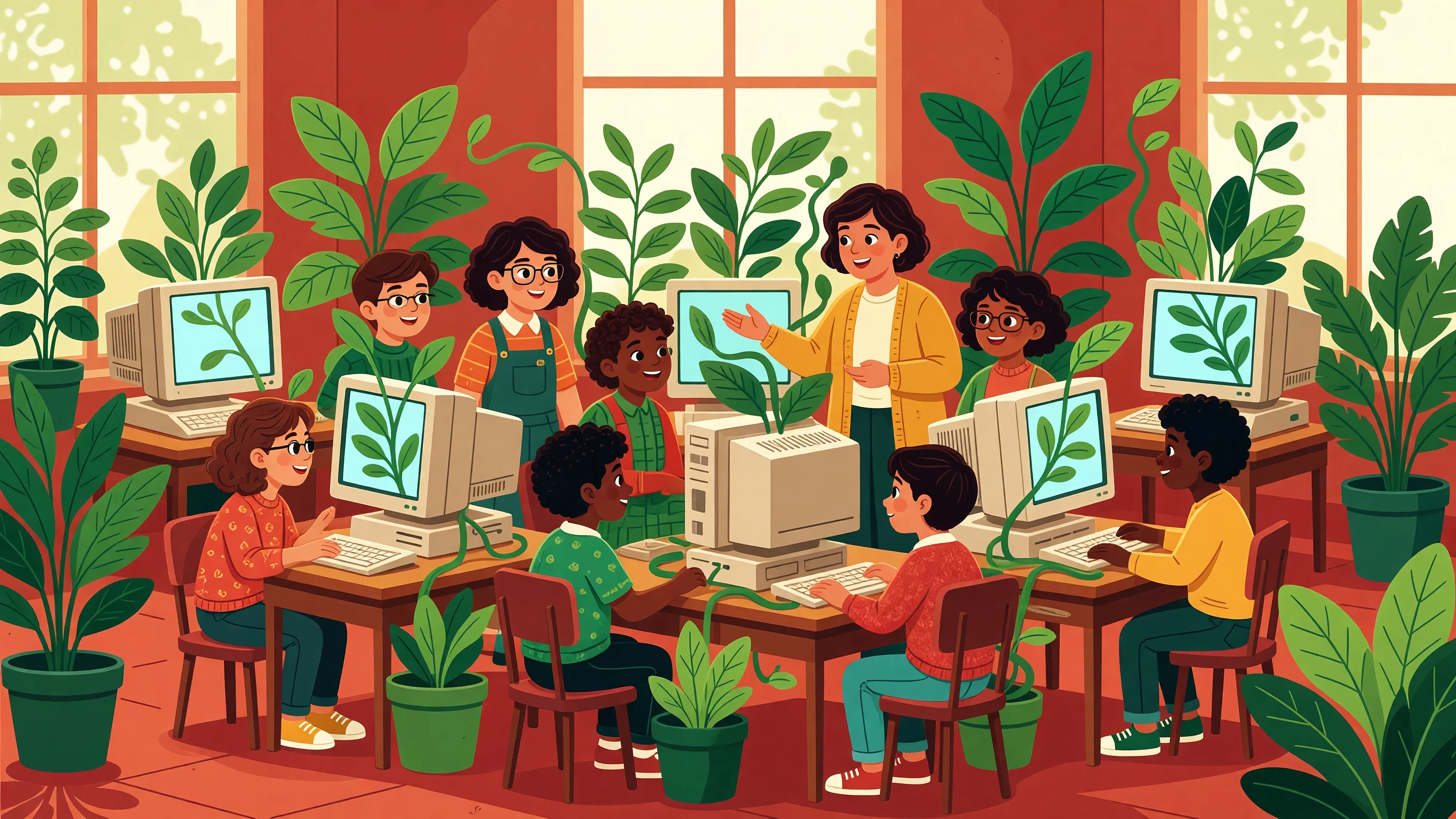
The first pillar of this strategy relies on the native operating system Boréal OS. Designed as a lightweight and secure Quebec Linux distribution, Boréal OS is installed directly on the hard drives of machines declared obsolete by tech giants. By bypassing artificial hardware requirements, this system extends the useful life of existing computers by five to ten years. For a school, this means the ability to keep its current computers, eliminate operating system licensing fees, and drastically reduce its carbon footprint, since extending hardware lifespan is the most effective way to limit the environmental impact of digital technology.
Once the machine is revitalized by Boréal OS, access to educational tools is achieved simply through a web browser using the ProductivIA platform. Within this no-code application environment, the EtudeIA application provides direct support to teachers and students. Designed for homework help and the generation of personalized exercises, EtudeIA relies on RAG (Retrieval-Augmented Generation) technology integrated into the platform's Document Database. This method anchors artificial intelligence responses exclusively in textbooks and educational materials provided by the teacher, thereby eliminating the risk of hallucination or algorithmic bias.
Finally, to guarantee full compliance with Law 25, the infrastructure can be configured to route all EtudeIA requests to Matania, the language model provider physically hosted in Quebec. School data and student interactions thus remain confined within a secure, sovereign silo, without ever transiting through foreign servers.
Going Further
The necessary transition toward more sober budget models in education invites us to rethink our relationship with digital infrastructure. Rather than submitting to the obsolescence and billing cycles imposed by tech monopolies, public institutions now have the opportunity to opt for local, modular solutions. How can school decision-makers initiate this shift toward technological autonomy that preserves both public finances and the environment? The answer likely lies in a pragmatic approach, where maximizing the value of existing assets takes precedence over the systematic consumption of new software.