Digital Overload in the Teaching Profession
The digital transition in Quebec schools has reached a saturation point. While ministries and school administrations continue to introduce new management, tracking, and learning platforms, resistance from teachers is growing stronger. This rejection does not reflect a principled opposition to technology, but rather weariness with what many describe as bloated software systems.
According to a report by the Centrale des syndicats du Québec (CSQ), the proliferation of uncoordinated digital tools contributes significantly to teachers' administrative workload, reducing the time they can devote to lesson preparation and direct student support. Similarly, according to UNESCO's global report on technology in education, the massive introduction of digital tools in schools too often occurs without consulting those directly affected, leading to high abandonment rates of the implemented systems.
Why Traditional Platforms Fail
To understand this resistance, one must analyze the very architecture of top-down technological solutions. Most educational platforms suffer from excessive ergonomic complexity. They require heavy training, constant updates, and tedious management of login credentials and permissions. For a teacher managing a class of thirty students, every minute spent configuring a tool or troubleshooting a connection is a minute stolen from pedagogy.
In addition, the security and privacy of minors' data have become critical issues, particularly under Quebec's Law 25. Teachers often find themselves caught between the obligation to innovate and a legitimate fear of using non-compliant tools that route student data to foreign servers. This centralization of AI infrastructure within American or Asian tech giants exposes institutions to non-compliance risks and widespread outages.
This is where the need for invisible technology comes in: systems capable of integrating naturally into daily classroom life without imposing an additional cognitive load. To achieve this, two key concepts of modern artificial intelligence must be demystified: RAG (Retrieval-Augmented Generation) and embeddings.
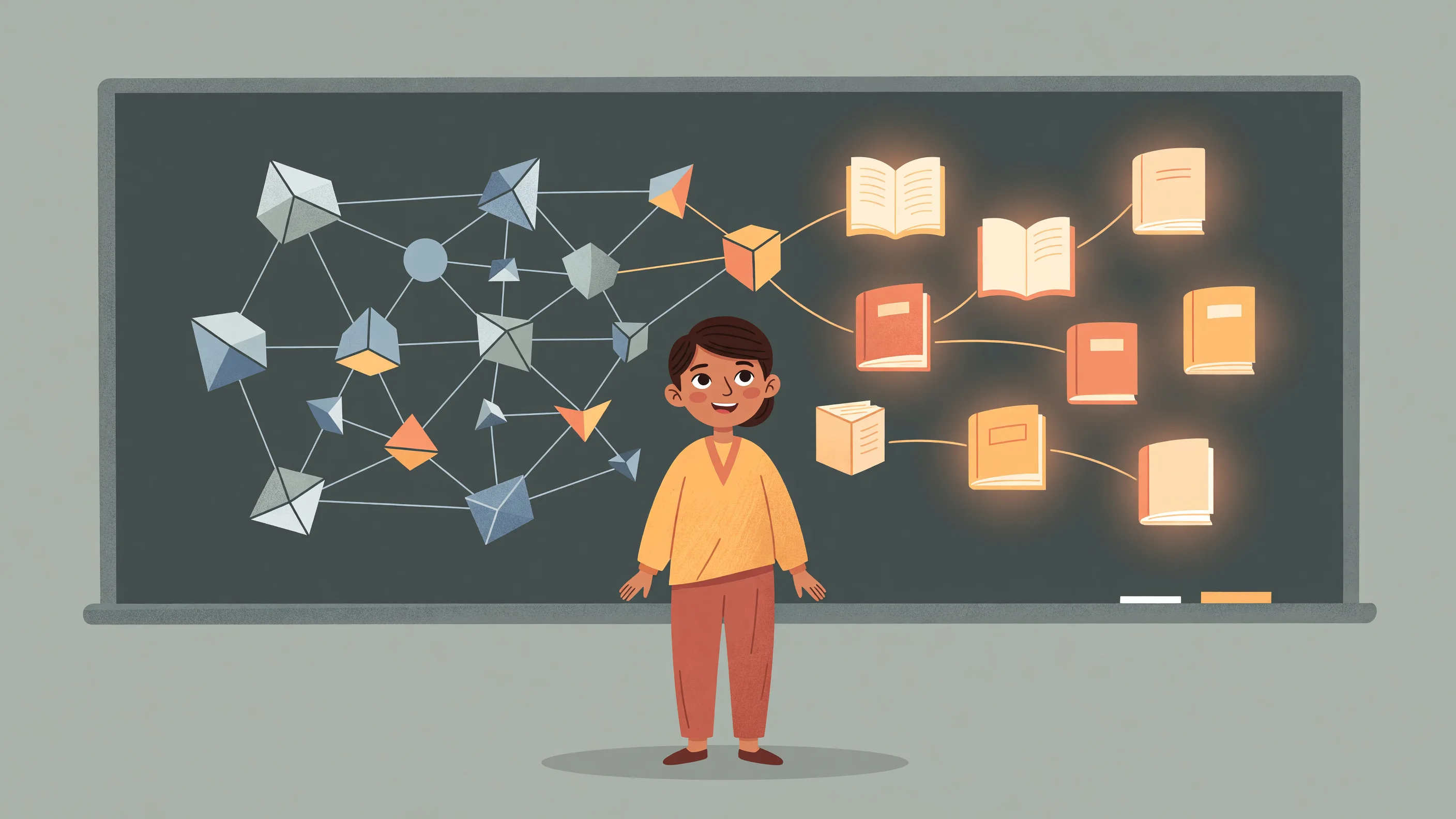
RAG, or retrieval-augmented generation, is a technique that anchors an AI model's responses in real, verified documents provided by the user. Rather than letting the AI invent answers based on the entire internet, RAG forces the system to search for answers exclusively within textbooks or the teacher's own course notes. This search relies on embeddings, which are vector representations that allow the machine to understand the deeper meaning of sentences rather than just simple keywords. For instance, if a student asks a question about photosynthesis, the system finds the relevant passage in the course document, even if the exact terms differ.
ProductivIA's No-Code Alternative
In response to these challenges, the ProductivIA platform offers a radically different approach, focusing on ease of use and seamless technology. Through its ÉtudeIA and Document Base applications, it provides a completely no-code environment that runs directly in the browser, eliminating the need for complex local installations or tedious configurations.
With the Document Base application, a teacher can drag and drop lesson plans, reading sheets, and exercises in PDF or Word format. The platform seamlessly analyzes and vectorizes these documents. Then, through the ÉtudeIA application, students access a personalized tutor that answers their questions based exclusively on the document memory provided by the teacher. There is not a single line of code to write, nor any obscure security settings to configure.
This simplicity comes with a guarantee of data sovereignty. Unlike solutions that passively export data abroad, ProductivIA allows all interactions to be confined within the organization's silo. School administrators can choose to route ÉtudeIA queries to Matania, a sovereign Quebec engine hosted locally. Student data never crosses borders and remains protected from extraterritorial laws such as the US Cloud Act, thereby ensuring full compliance with Law 25.
Furthermore, this software approach fits perfectly into a vision of global digital sobriety. If a school has aging hardware that has been declared obsolete due to the system requirements of commercial operating systems, it can install the sovereign Boréal-OS operating system on its machines. This lightweight system breathes new life into older computers, allowing teachers and students to open their browsers and instantly use the ProductivIA suite. The hardware is rehabilitated, the applications are sovereign, and the AI is secure.
Looking Ahead
The success of the digital transition in schools does not depend on the power of algorithms, but on their acceptance by those who bring them to life every day. By replacing complex platforms with invisible, no-code tools that respect teachers' professional autonomy, educational institutions can finally reconcile technological innovation with their pedagogical mission. The question remains open: will public decision-makers choose to prioritize simplicity and local sovereignty over the centralized promises of digital giants?