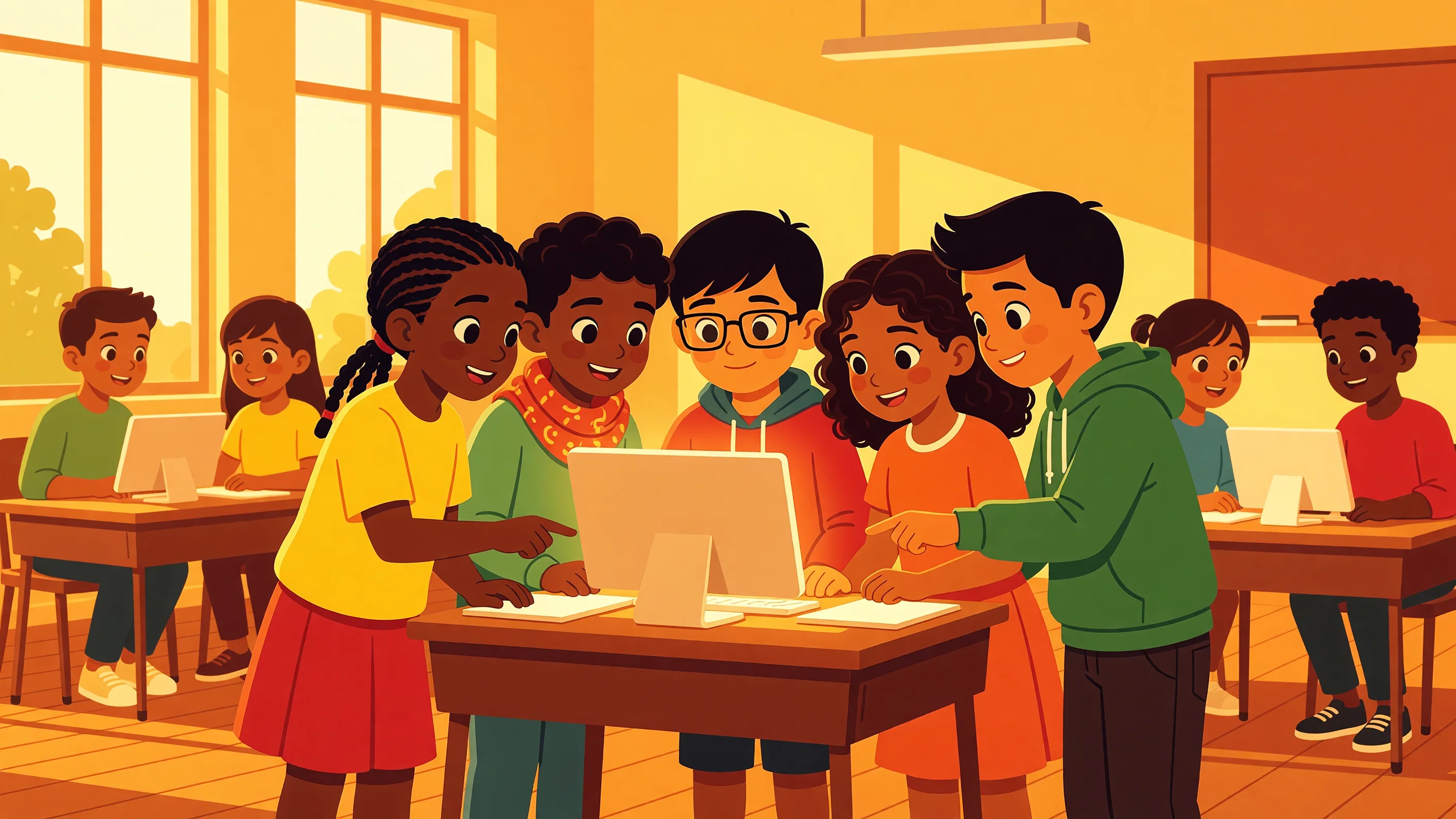
The Indian Announcement: Training Ten Million Youth in the Era of Artificial Intelligence
During Independence Day celebrations in New Delhi, Indian Prime Minister Narendra Modi announced a major national initiative: offering free artificial intelligence training to ten million young people over the coming year, along with free online preparation courses for competitive exams. According to reports by the Hindustan Times and the Pakistani daily Dawn, this measure aims to ease the financial burden on families facing an extremely competitive education system, while leveraging the country's public digital infrastructure.
This announcement comes amid social tensions and student protests that have recently shaken India's education sector. By promising free access to cutting-edge educational resources and AI skills, the Indian government is attempting to transform a demographic challenge into a driver of technological growth. However, such a mass rollout raises fundamental questions about technical viability, equitable access, and the sovereignty of the tools used to train the next generation.
The Challenges of Mass Learning: Infrastructure and Hardware Barriers
The desire to democratize access to artificial intelligence quickly runs into material and economic realities. To use the most powerful large language models (LLMs), users generally need recent computers, a constant high-speed internet connection, and, often, paid subscriptions to centralized services based abroad. According to a UNESCO report on generative artificial intelligence in education, this technological dependence risks widening the digital divide between the Global North and South, as well as within individual populations.
Furthermore, integrating AI into schools raises the issue of information reliability. General language models are prone to "hallucinations," a phenomenon where the AI generates factually incorrect answers presented in a convincing manner. For a student in the learning phase, these errors can be particularly detrimental. This is where the need for grounding techniques like RAG (Retrieval-Augmented Generation) comes in, which involves linking AI responses to databases of verified documents approved by teachers.
Lightweight Architecture: The Key to Equitable Educational Access
For AI education to be truly universal, tools must overcome hardware barriers. If every student needs the latest graphics processor or bandwidth saturated by constant requests to Californian servers, the promise of free access collapses under the weight of infrastructure costs. The solution lies in software architectures capable of running directly in a standard web browser, without requiring complex installations or heavy configurations.
This approach also helps meet privacy requirements. By limiting the transit of students' personal data to third parties, educational institutions comply with personal information protection regulations, such as Law 25 in Quebec. Using sovereign, locally hosted AI models ensures that a young person's learning journey is not transformed into advertising data.
The ProductivIA Response: EtudeIA and GoIA Serving Decentralized Learning
The Quebec platform ProductivIA fits precisely into this philosophy of accessibility and lightweight design. Designed to run entirely in the browser, it requires no local installation, making it immediately operational on diverse or older computer fleets.
The EtudeIA app concretely illustrates this approach applied to education. Designed as a personal tutor, it uses RAG technology by connecting to the Document Base app. Teachers or students can upload textbooks, course notes, or exercises in PDF or Word format. The AI invents nothing: it extracts its answers solely from the provided documents, thereby eliminating the risk of pedagogical hallucination. In addition, the GoIA app allows students to compare responses from different language models side by side, fostering critical thinking in the face of algorithmic bias.
This software accessibility makes perfect sense when combined with other layers of Quebec's sovereign ecosystem. For example, a school with computers declared obsolete by Windows 11 requirements can give them a useful second life using Boreal-OS, a lightweight native operating system. Once installed on the hard drive, it allows users to open a browser and instantly access the ProductivIA suite. If the institution requires absolute confidentiality, the administrator can configure the orchestrator so that EtudeIA requests are processed exclusively by Matania, the AI model provider physically hosted in Quebec. The machine, the application, and the AI engine then form an entirely local and eco-responsible chain.
Going Further: Toward the Sovereignty of Knowledge
The Indian initiative reminds us that digital education can no longer settle for training passive users of foreign proprietary technologies. It forces a reflection on the ownership of educational tools and the control of infrastructure. By prioritizing lightweight, no-code solutions that respect data sovereignty, educational institutions equip themselves with the necessary means to guide young people toward a critical and autonomous mastery of artificial intelligence.