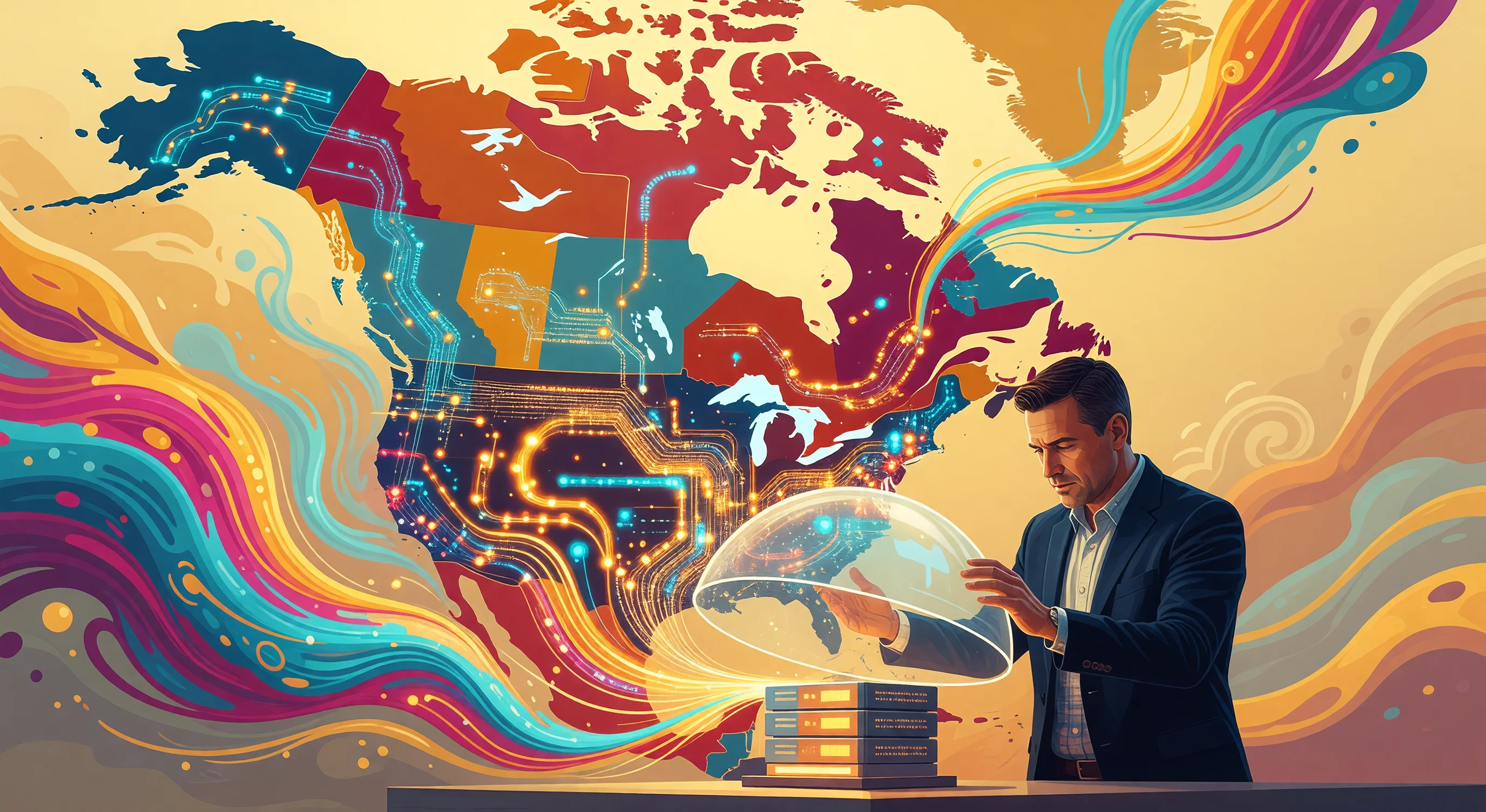
The Shadow of Technological Dependence on Free Trade
The renewal of the Canada-United States-Mexico Agreement (CUSMA) is unfolding in a climate of sharp diplomatic and economic tensions. Amid threats of unilateral tariffs from Washington and political rhetoric occasionally framing Canada as a mere territorial extension of the United States, Canadian negotiators are working to secure a stable trade framework for the next sixteen years. While public debates traditionally focus on softwood lumber, the automotive sector, or agriculture, a critical issue remains largely overlooked: the sovereignty of our digital infrastructure and business data.
In today's economy, data flows have replaced a significant portion of physical trade. Yet, the vast majority of Quebec businesses and public institutions entrust their strategic data and artificial intelligence tools to providers concentrated within US borders. This centralization exposes local organizations to cross-border legal and political risks that are often underestimated.
The Latent Conflict Between CUSMA, the CLOUD Act, and Law 25
Understanding the vulnerability of Quebec organizations requires examining the legal framework governing digital trade. Chapter 19 of CUSMA strictly prohibits signatory countries from imposing local data localization requirements as a condition for doing business. While this provision facilitates the free flow of data, it also encourages the concentration of infrastructure among US-based tech giants.
This concentration creates a major compliance challenge under Quebec law. Indeed, Law 25, which governs the protection of personal information, requires organizations to conduct a rigorous privacy impact assessment before transferring any data outside the province. However, US technological solutions are subject to extraterritorial laws such as the CLOUD Act and Section 702 of the Foreign Intelligence Surveillance Act (FISA). These statutes allow US authorities to demand access to data stored by companies under their jurisdiction, even if the physical servers are located on Canadian soil. According to a study published by the Centre interuniversitaire de recherche en analyse des organisations (CIRANO), this legal duality creates constant uncertainty for local businesses, leaving them caught between Quebec compliance requirements and foreign surveillance prerogatives.
An Architectural Alternative to Secure Critical Operations
In the face of these geopolitical uncertainties, the solution is not technological isolation, but rather the adoption of software architectures designed to guarantee data sovereignty by design. This is precisely where the ProductivIA platform fits in, offering a completely no-code productivity environment that runs directly in the browser, free from heavy external software dependencies.
Through the Nuage application, each organization has an isolated logical storage space, known as a silo. Unlike traditional cloud solutions where data transits opaquely across international networks, the ProductivIA architecture allows organizations to maintain absolute control over the physical location of their files. Administrators can choose to host these silos on local infrastructure, ensuring strict compliance with Law 25.
This sovereignty also extends to artificial intelligence processing. When a user queries the Central Assistant to analyze confidential documents or automate administrative tasks, the platform imposes no vendor lock-in. Instead of routing these requests to servers in the United States or Asia, the orchestrator can be configured to exclusively use the sovereign Matania model, whose servers are physically located in Quebec. This approach delivers the power of generative AI while ensuring that trade secrets and personal information never cross the border.
Toward Local Digital Resilience
The renegotiation of CUSMA demonstrates that international trade agreements are never set in stone and that the rules of the game can change with political shifts. In this context, technological dependence represents a major operational risk to business continuity and national security.
By prioritizing solutions that decouple application power from foreign infrastructure, Quebec institutions and businesses can strengthen their resilience. Building a sovereign ecosystem that combines an independent operating system like Boréal-OS, a no-code application environment like ProductivIA, and a local AI engine like Matania offers a practical path toward digital autonomy, shielded from cross-border political fluctuations.