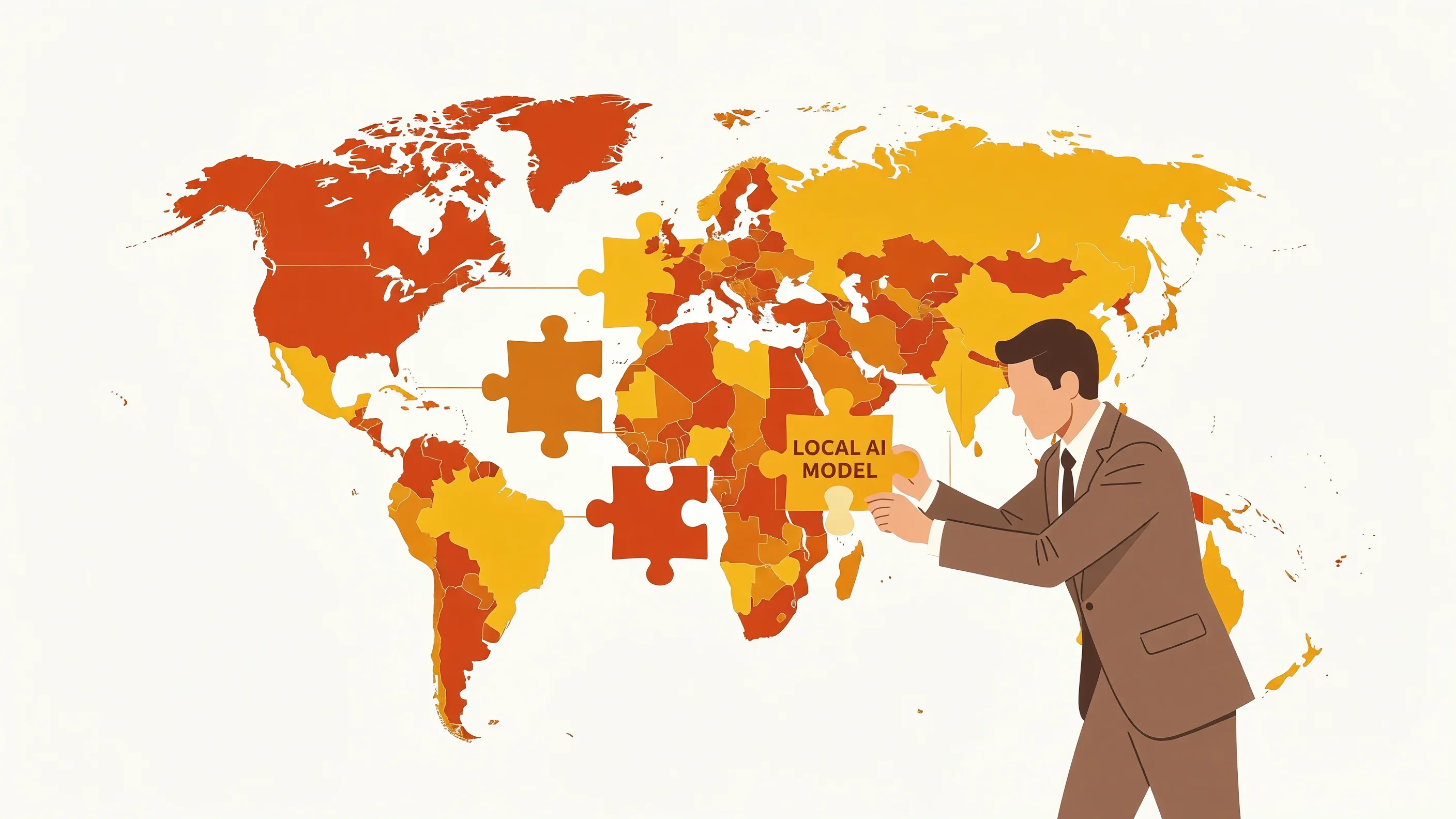
The Clash of State Sovereignty and Tech Giants
When national sovereignty forces Apple to adopt Qwen in China, it proves that the one-way artificial intelligence of the GAFAM giants is now hitting legal borders. To deploy its artificial intelligence features, known as Apple Intelligence, the Cupertino-based multinational had to resolve to negotiate partnerships with local players, notably Alibaba for its Qwen model and Baidu. According to information reported by the Hindustan Times, this decision stems directly from the strict requirements of the Cyberspace Administration of China (CAC), which imposes prior approval on every large language model (LLM) before its public release.
This geopolitical compromise highlights a reality that proponents of a global, centralized AI have long tried to ignore: data, its transit, and the algorithms that process it are subject to the laws of the territories hosting them. In China, regulations require not only that user data does not cross national borders, but also that models respect local ethical and political criteria. For Apple, which built its empire on a closed, vertically integrated ecosystem, this forced decoupling represents a major strategic shift.
The End of the Universal AI Provider Illusion
This Chinese precedent is not an isolated case, but a symptom of an accelerated regionalization of artificial intelligence. According to analyses by the research firm Gartner, the quest for "digital sovereignty" has become a priority for many governments worldwide. Public and private organizations are realizing that relying exclusively on a single API hosted in a foreign jurisdiction exposes them to major legal, operational, and geopolitical risks. Whether it is the European Union Artificial Intelligence Act (AI Act) or Law 25 in Quebec, compliance requirements are forcing decision-makers to demand complete traceability of data flows.
To bypass these obstacles, the technical solution does not lie in constantly rewriting applications with every regulatory change, but in architectural decoupling. Software architecture must hermetically separate the user interface from the AI execution layer. Without this precaution, organizations expose themselves to costly technological lock-in and constant vulnerability to unilateral decisions by foreign providers or legislators.
ProductivIA's Decoupled Architecture as a Structural Response
What tech giants are discovering under the constraint of national laws is the very foundation of the Quebec-based platform ProductivIA. Designed on a principle of sovereignty by architecture, ProductivIA entirely separates the no-code application environment from the orchestration layer of artificial intelligence models. This approach allows organizations to instantly meet compliance requirements without disrupting the end-user experience.
In the ProductivIA ecosystem, this flexibility is concretely demonstrated through applications like GoIA and the Assistant. GoIA allows side-by-side comparison of responses from different models (whether from OpenAI, Anthropic, or local solutions). The Assistant, for its part, acts as an orchestrator capable of calling different application services. If an organization must comply with Quebec's Law 25 on the protection of personal information, the silo administrator can, with a single click in the management console, redirect all requests from the Assistant and GoIA to the sovereign Matania model.
Matania, physically hosted on infrastructure located in Quebec, is built precisely on models from the Qwen family, optimized to ensure high-performance and secure execution. For the end user (whether a teacher, legal advisor, or business manager), the transition is completely seamless: the interface remains identical, the usual work tools remain functional, but the data never leaves Quebec territory. This no-code approach eliminates the need to modify the application's source code, thereby avoiding the security risks associated with "vibe coding" (the rapid production of code by AI without auditing or oversight).
Toward a Complete and Coherent Sovereign Stack
Global regulatory evolution shows that digital sovereignty cannot be negotiated piecemeal. It requires consistency across the entire computing stack. This is why the Quebec sovereign ecosystem offers a three-tier response: the physical machine, the application environment, and the artificial intelligence engine.
While ProductivIA resolves application sovereignty in the browser and Matania secures AI data processing, the native Boréal-OS operating system completes this stack by regaining control of the hardware. By installing Boréal-OS on their hard drives, institutions and businesses free themselves from the intrusive telemetry of proprietary American operating systems while extending the useful life of their computer fleets. This integration demonstrates that it is possible to build a modern, high-performance work environment fully compliant with local legal requirements, without submitting to the dictates of tech monopolies.