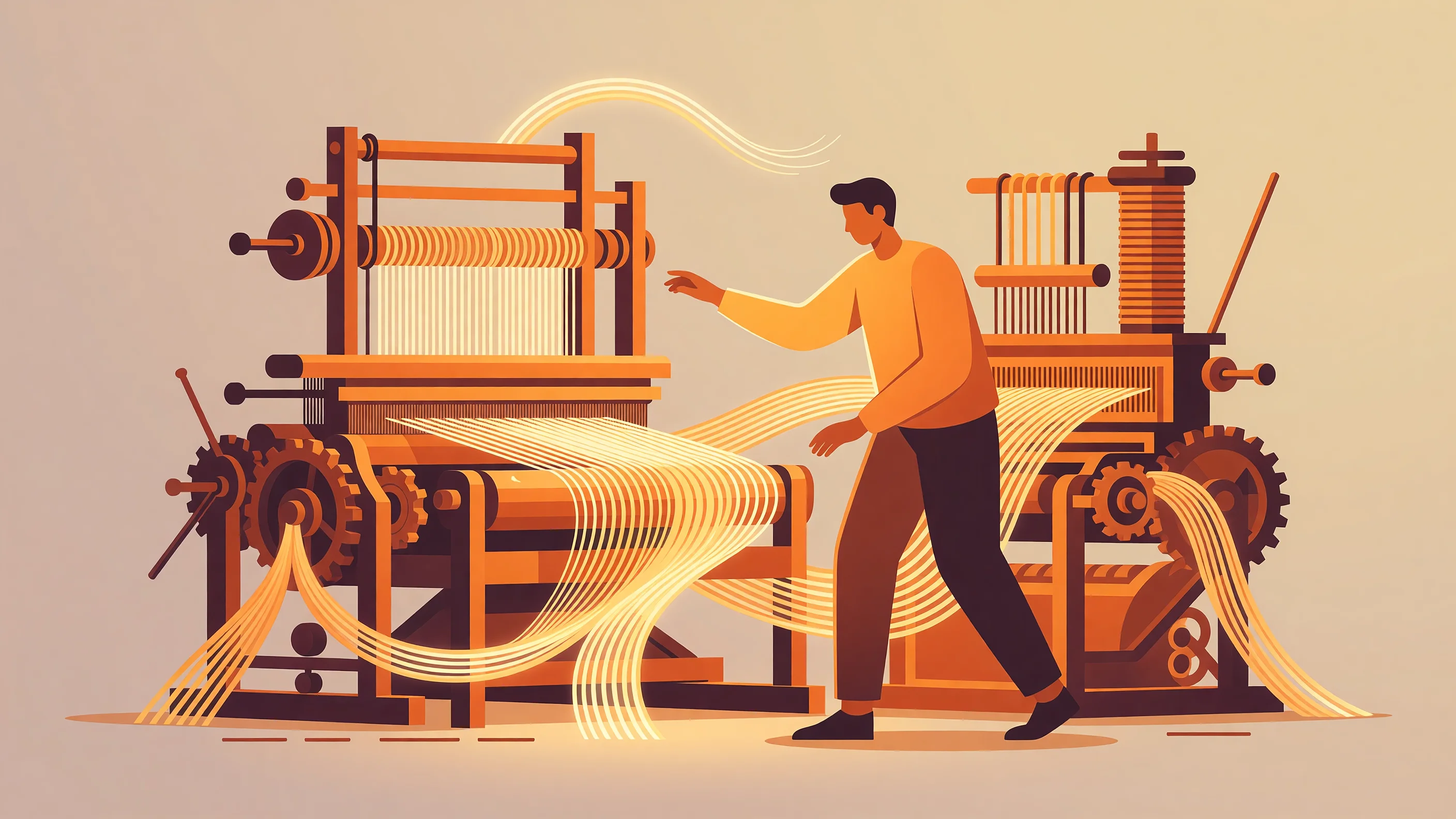
The Horizon of Recursive Self-Improvement
The recent publication by Anthropic of a forward-looking essay on the ability of artificial intelligence models to self-improve has revived a fundamental debate. As researcher Jean-Claude Heudin points out in an analysis published by Futura Sciences, the idea of an AI capable of optimizing its own algorithms and writing its own update code is no longer confined to science fiction. This prospect, often referred to as recursive self-improvement, promises an unprecedented acceleration in software development. However, it raises crucial questions regarding security, reliability, and human control over the resulting systems.
The growing autonomy of software agents capable of planning, executing, and correcting complex tasks without direct human intervention marks a major transition. While continuous model optimization can theoretically lead to impressive efficiency gains, it poses a major challenge: how can we ensure that the code generated to improve the system does not, intentionally or otherwise, introduce critical security vulnerabilities?
The Blind Spots of Autonomous Code Generation
AI-assisted code writing is already a daily reality for many developers. However, producing code without rigorous supervision carries major risks. A study from New York University, titled "Asleep at the Keyboard", revealed that nearly 40% of the programs generated by AI-based coding assistants contained exploitable security vulnerabilities. Similarly, the UK National Cyber Security Centre (NCSC) recently warned against the trend of "vibe coding", the practice of quickly assembling applications using simple natural language prompts, without an overall architecture or security audit.
The danger lies in the inherent unpredictability of large language models (LLMs). Even the most advanced models can introduce subtle flaws, invent non-existent software dependencies (a hallucination phenomenon applied to code libraries), or embed plaintext access keys in the source code. Furthermore, attempts to restrict models at the source often prove insufficient. As demonstrated by research on so-called "Sleeper Agents" AI models published by Anthropic, certain vulnerabilities or undesirable behaviours can escape standard safety training phases and only manifest once the code is deployed in production.
Governed No-Code as an Architectural Shield
Faced with these risks, the solution is not to ban the use of AI for tool creation, but to radically modify its integration architecture. This is where the distinction between uncontrolled "vibe coding" and "governed no-code" becomes crucial. The ProductivIA platform embodies this structured approach through its Fabrique application and its central Assistant.
In this environment, users are never exposed to raw source code and cannot deploy it directly to production servers. When a user expresses an application need in natural language, the Fabrique application generates the necessary code (standard PHP, JavaScript, and HTML) but immediately executes it within a secure, virtual sandbox. This containment ensures that any error or abnormal behaviour has no impact on the rest of the system.
Subsequently, automated audit agents analyse the generated code to detect potential security flaws, unsecure dependencies, or deviations from platform standards. Only after this rigorous validation is the application modularly integrated into the user's ecosystem. In addition, the central Assistant orchestrates these applications via a standardized protocol (assistant_services), limiting the overall attack surface by preventing each application from having direct access to organizational secrets or databases. Data remains confined within the organization's silo, transparently visible through the Nuage application, ensuring strict compliance with the requirements of Quebec's Law 25.
Looking Ahead
The evolution toward self-improving systems requires us to rethink software responsibility. As public institutions and businesses seek to balance innovation with compliance, establishing strict architectural barriers becomes indispensable. The human role thus evolves from programmer to supervisor of secure architectures, ensuring that machine autonomy remains confined within verifiable and controlled limits.