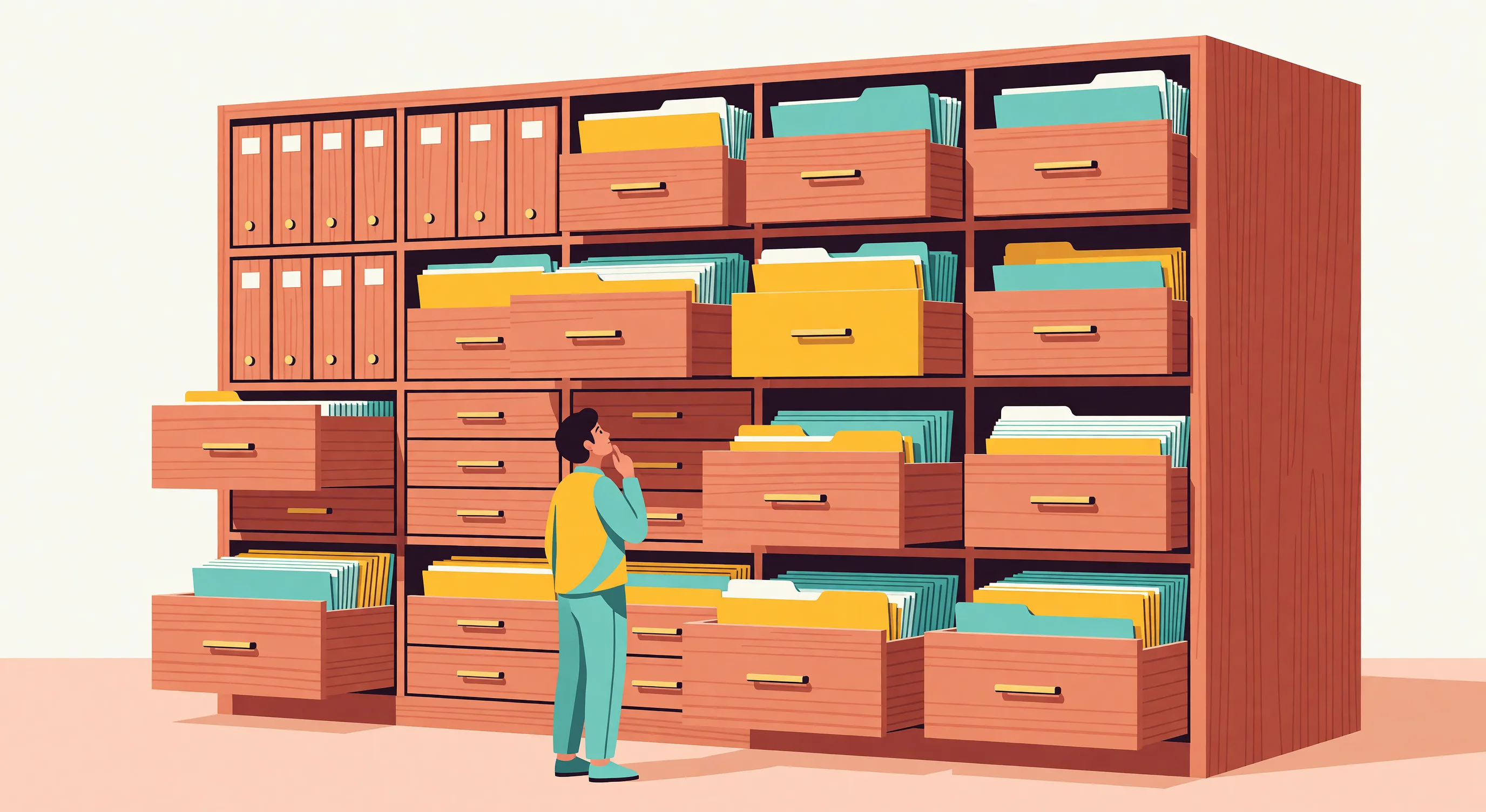
AI as the Archivist of Our Personal Files
When artificial intelligence acts as an archivist for your personal files, the line between organizational assistance and document surveillance becomes thin. Recently, tech giant Google announced the rollout of a new feature within its cloud storage platform, Google Drive. Powered by its Gemini artificial intelligence model, this tool automatically organizes loose files by analyzing the structure of the user's existing folders.
This announcement, reported by several specialized media outlets such as 01net, promises to solve the eternal problem of digital clutter. With a single click, users delegate the tedious task of sorting, renaming, and organizing their documents to the machine. Yet, behind this promise of efficiency lies a profound shift in our relationship with data ownership and privacy.
Indexing Mechanisms and the Risks of Opacity
For artificial intelligence to classify documents effectively, it must first understand their content. This process relies on generating embeddings, which are vector representations that translate the semantic meaning of text into mathematical coordinates. By comparing these vectors, the algorithm determines whether a financial report should go into the accounting folder or the active projects folder. This analysis requires a complete and continuous reading of all files stored by the user.
This continuous indexing raises major ethical and legal questions. By entrusting directory organization to a proprietary model hosted on remote servers, users implicitly accept that their personal, medical, or corporate documents will be scrutinized by third-party algorithms. In Quebec, Law 25 imposes strict rules regarding the protection of personal information, notably requiring total transparency in data processing and rigorous assessments of cross-border transfers. As indicated by the guidelines of the Commission d'accès à l'information du Québec, the automated processing of sensitive data without explicit and informed consent can constitute a clear violation.
Furthermore, automatic directory reorganization introduces a risk of opacity. If the AI mistakenly moves a confidential document to a shared folder, the resulting data leak becomes almost invisible to the user. Losing control over the structure of one's own files represents a step backward from the fundamental principle of controlling one's digital workspace.
The Sovereign Response: Transparency and Non-Destructive Search
In response to this trend toward opaque and centralized reorganization, Quebec-based platform ProductivIA offers a radically different philosophy, focused on transparency and preserving the structure chosen by the user. Within this ecosystem, the Nuage application guarantees that files remain exactly where they were placed. No artificial intelligence unilaterally modifies the folder structure or moves items in the background. Transparency is absolute: users retain complete control over their storage space, and all data can be viewed and exported at any time.
To solve the problem of document clutter without altering file structures, ProductivIA relies on the Base documentaire application. Rather than physically moving documents to sort them, this application uses Retrieval-Augmented Generation (RAG). Documents, including PDFs, Word files, and spreadsheets, are securely indexed within the organization's logical silo. Users can then query their document base using natural language. The artificial intelligence instantly retrieves relevant information by anchoring itself exclusively in real sources, without ever changing the physical location of the files or compromising their confidentiality.
This approach reconciles the power of semantic search with strict respect for privacy. Moreover, by combining this architecture with the sovereign AI engine Matania, hosted locally in Quebec, organizations ensure that their data never transits through foreign infrastructure subject to extraterritorial laws like the US Cloud Act.
Toward User-Friendly Document Management
Automating document management through AI raises a fundamental question: must we adapt our filing structures to the requirements of algorithms, or should we design tools capable of navigating our own human logic? By prioritizing non-destructive semantic search over automated and opaque sorting, organizations can benefit from the best of both worlds: increased efficiency and preserved digital sovereignty.