The Rise of Agentic AI in Canadian Organizations
The integration of artificial intelligence in professional environments is crossing a new technological frontier. Organizations are no longer content with using AI as a simple tool for writing or translation assistance. Today, we are witnessing the deployment of autonomous agents capable of planning, making decisions, and executing complex tasks without constant human intervention. According to the Work Trend Index, this transition toward agency poses a major challenge for businesses: how to adopt these cutting-edge technologies without stripping workers of their decision-making power and expertise?
This rapid evolution raises legitimate questions within IT and human resources departments in Quebec. The fear of seeing critical processes automated in an opaque manner, or of losing the traceability of decisions, is pushing organizations to re-evaluate the boundary between technological assistance and the outright substitution of human action.
Understanding the Mechanisms and Risks of Artificial Agency
Agentic AI differs from classic conversational models in its ability to act autonomously within a digital environment. Where a traditional chatbot is limited to answering a specific question, an AI agent can break down a general goal into several subtasks, call external tools such as databases or calendars, and adjust its behaviour based on the results obtained. This operation relies on reasoning and action architectures that allow the machine to simulate a form of logical planning.
However, this increased autonomy carries risks documented by several researchers and institutions. A study published by the Organisation for Economic Co-operation and Development (OECD) highlights that losing control over automated decision-making processes can lead to a decline in employee engagement and an erosion of their critical skills. When the machine makes intermediate decisions invisibly, the human user loses their understanding of the workflow, making auditing and error correction extremely difficult.
Furthermore, the black-box phenomenon is heightened when AI systems perform silent substitutions. If a tool encounters an error or limitation and autonomously decides to modify its parameters or call upon an unvalidated third-party service to bypass the problem, the professional liability of the organization is compromised. It is this challenge of human agency that software designers must now solve.
The ProductivIA Approach: Deterministic and Transparent Orchestration
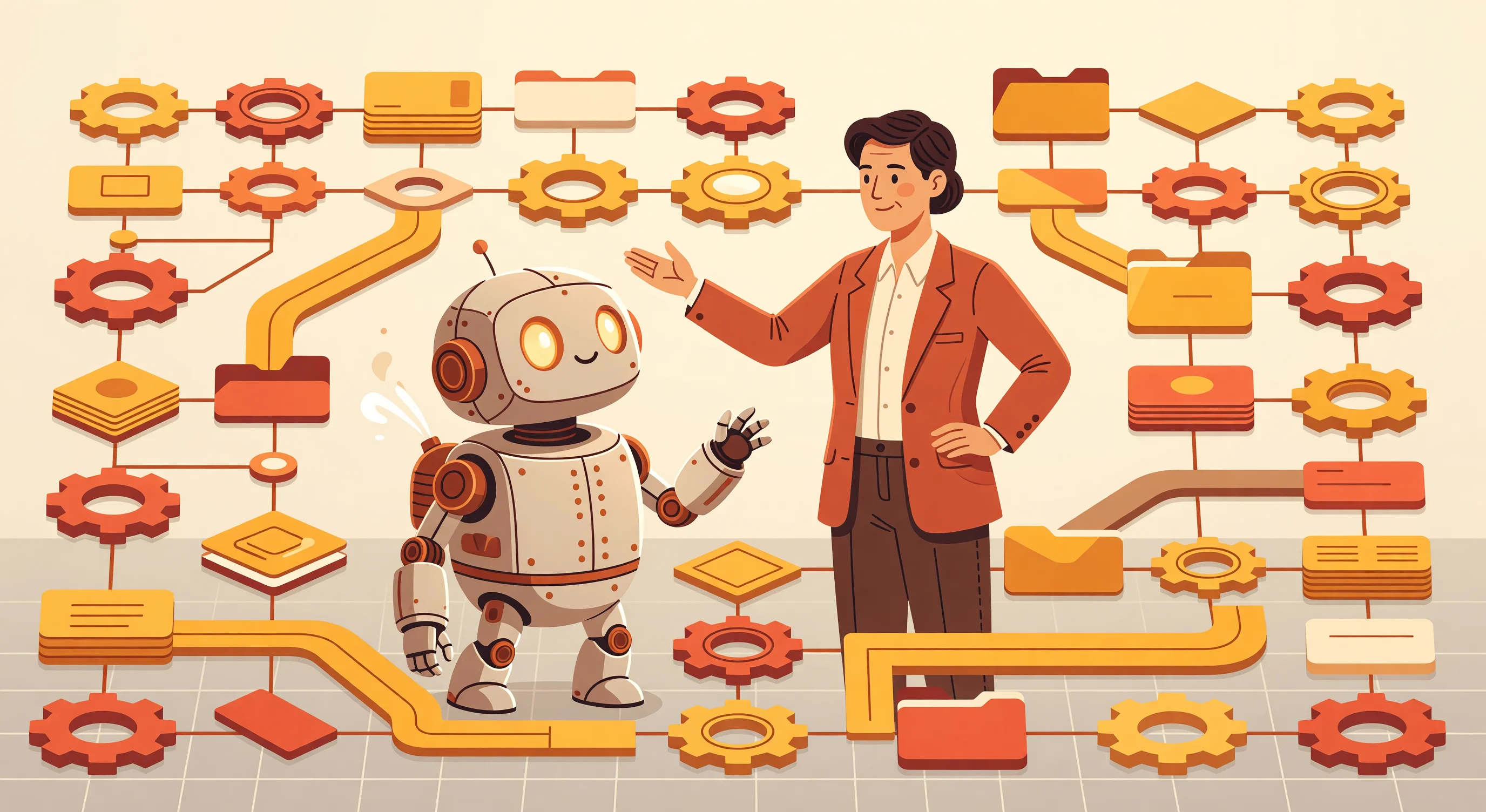
It is precisely to meet this need for control and transparency that the architecture of the ProductivIA platform was designed. The Assistant application does not function as an opaque, autonomous entity, but as an orchestrator rigorously governed by the standardized protocol named assistant_services. This mechanism requires every application on the platform, whether managing emails, calendars, or document databases, to explicitly declare the actions it exposes and authorizes.
The Assistant can only act within this strict and defined framework. Every service call and data transfer from one application to another is tracked and subject to user validation. This approach ensures that AI remains an execution assistant and never replaces human decision-making power.
Another fundamental pillar of this design philosophy is the absolute refusal of silent failures. If a language model or service encounters an anomaly while executing a task, the platform does not attempt to hide the error by invisibly switching to another provider not configured by the administrator. Instead, the error is reported directly and explicitly to the user. This transparency maintains complete trust in the system's behaviour.
Finally, the Nuage application acts as an open registry for the entire ecosystem. All data handled, generated, or stored by the Assistant can be immediately viewed, audited, and exported by users within their storage space. By eliminating software blind spots, the platform allows organizations to comply with the requirements of Quebec's Law 25 on personal information protection, while still benefiting from the efficiency gains offered by automation.
Going Further
The transition to AI-assisted work environments requires reflection that goes beyond simple short-term productivity gains. True efficiency lies in the ability to design systems where technology amplifies human intelligence without ever bypassing it. Organizations will need to determine how to train their teams to become critical supervisors rather than passive spectators of automation. The architectural choices made today will shape the nature of tomorrow's work.