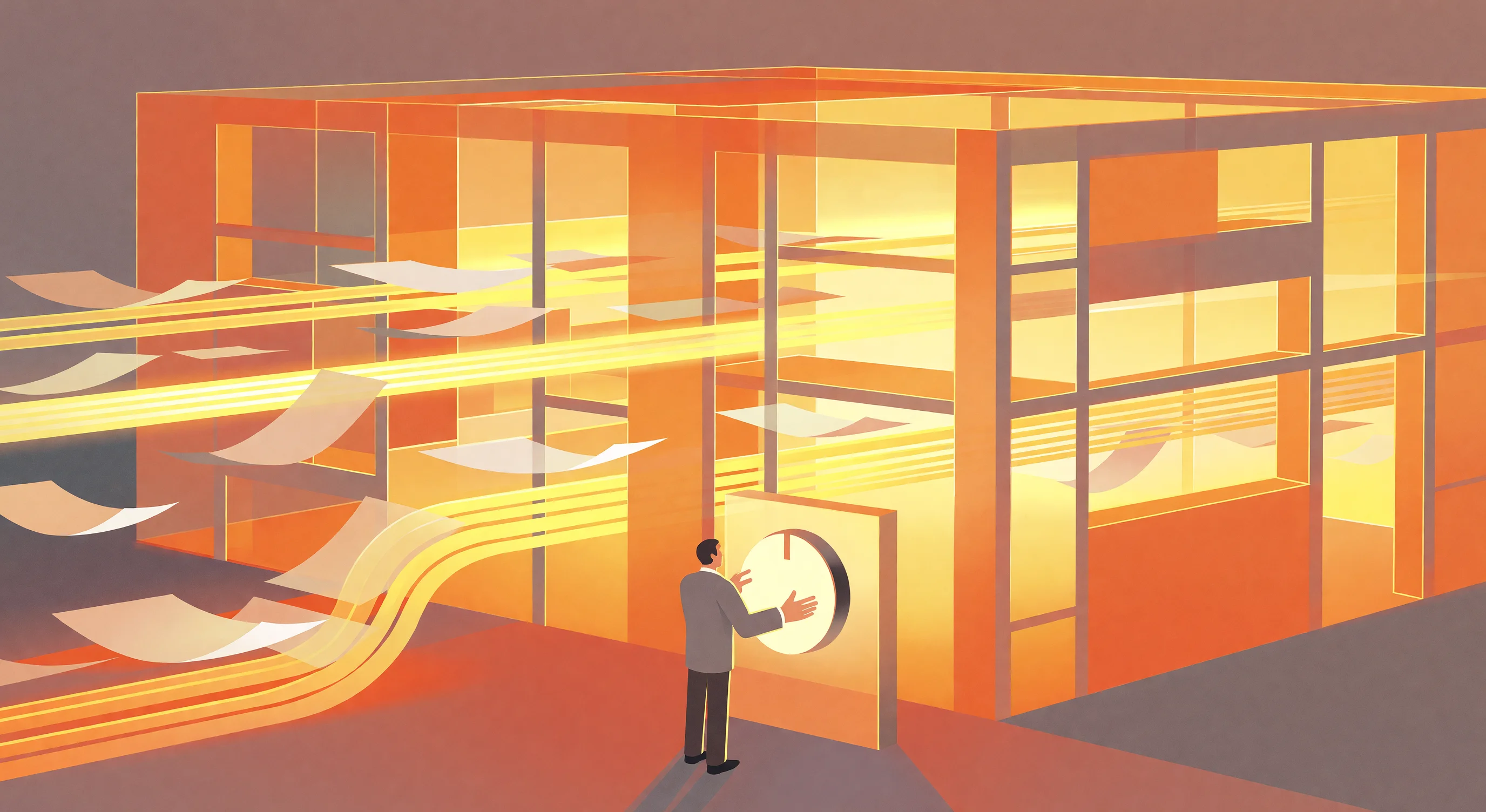
The Rise of Autonomous Agents in the Workplace
The integration of artificial intelligence within organizations is reaching a decisive milestone. We are moving beyond passive chatbots designed to answer isolated questions and entering the era of agentic AI. According to data compiled by the Work Trend Index, a growing share of skilled professionals now integrates artificial intelligence not merely as a writing tool, but as an active collaborator capable of initiating actions.
This transition toward agency is characterized by the ability of systems to plan complex tasks, use third-party tools, and make operational decisions autonomously. In Canada, this evolution is profoundly redefining work organization, raising fundamental questions about the division of responsibility between humans and machines. In the face of this growing technical autonomy, organizations must design governance frameworks capable of maintaining effective human control.
The Risks of Unchecked Delegation
The temptation to automate entire administrative processes carries major technical and legal risks. When language models are authorized to execute scripts or call application programming interfaces (APIs) without supervision, the slightest hallucination or logical error can result in file deletions, erroneous emails, or security breaches. The UK National Cyber Security Centre (NCSC) has issued clear warnings against using unsupervised autonomous agents, calling the risks of intrusion and data manipulation intolerable for corporate infrastructure.
On the regulatory front, Quebec legislation imposes strict guidelines. Section 12.1 of the Act respecting the protection of personal information in the private sector (Law 25) stipulates that any organization using a fully automated decision-making system must inform the individuals concerned and offer them the opportunity to submit observations. Blindly delegating tasks to AI agents complicates compliance with this transparency obligation, as the decision chain quickly becomes opaque even to administrators.
Governed Orchestration: The ProductivIA Approach
To reconcile the efficiency gains of agentic AI with security requirements, the Quebec-based ProductivIA platform offers a rigorously governed orchestration model. At the centre of this architecture is the Assistant application, designed to coordinate various tasks without ever bypassing human validation.
Unlike unsupervised rapid-development approaches, ProductivIA's Assistant interacts with other platform applications through a strict protocol named assistant_services. This mechanism is akin to a secure software plumbing system: each application declares precisely which actions it authorizes the Assistant to perform. For example, if the Assistant needs to prepare a financial report, it can query the Document Base to extract numerical data and then draft a copy. However, no final file modifications or external transmissions can occur without explicit user confirmation in the interface.
This design philosophy ensures that humans remain the final validators (the human-in-the-loop principle). In addition, the Cloud application offers complete transparency over processing history: every document generated, modified, or moved by the Assistant is immediately visible, auditable, and exportable by the user. There are no hidden databases or invisible background processes.
Toward Responsible and Sovereign Autonomy
Mastering agency is not limited to the user interface; it also encompasses the location of computing infrastructure. As the Canadian government develops its national artificial intelligence strategy to curb the flight of intellectual property abroad, the choice of execution engines becomes strategic.
By integrating the sovereign model provider Matania, hosted locally in Quebec, ProductivIA enables public institutions and businesses to run complex agentic workflows without their confidential data transiting through foreign servers. The Assistant's orchestration can thus be configured to use local models exclusively, ensuring perfect compliance with Law 25 while maintaining optimal performance.
The future of work does not lie in erasing human expertise in favour of autonomous algorithms, but in implementing no-code productivity tools capable of streamlining repetitive tasks under the constant supervision of those who direct them.